A sunset dolphin cruise in Charleston works because bottlenose dolphins live in the harbor year-round and feed there at golden hour. Our two-hour sunset run leaves Shem Creek nightly, seats are $59 ($49 for kids 12 and under), and sightings are common. They are wild animals, so no one can promise one.
If you want dolphins and a sunset on the same evening, book the sunset cruise. Bottlenose dolphins feed in Charleston Harbor at golden hour, and on our two-hour run out of Shem Creek, sightings on the ride out and the ride home are common. Common is the honest word. I won't promise you a dolphin on any given night, because they're wild animals working their own schedule.
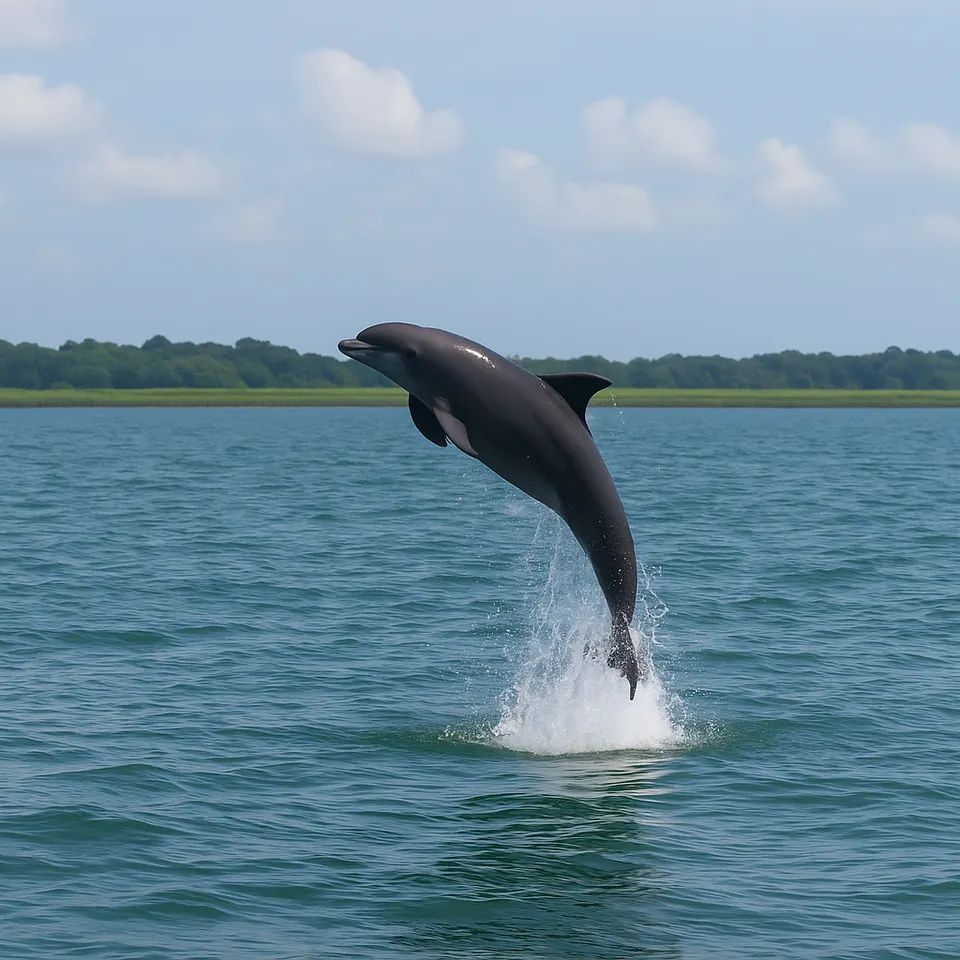
What I can do is make you better at seeing them. Most first-timers miss their first dolphin because they're scanning the horizon for the whole animal, the way it looks on a postcard. What you're actually hunting for is smaller, closer and gone in a second. Once you know the shape, you'll be the one pointing.
Bottlenose dolphins live in these waters all year
South Carolina has an estimated several hundred bottlenose dolphins, and the state's Department of Natural Resources describes them as year-round residents of our nearshore coastal waters. They grow to about 12 feet and average 400 to 600 pounds. There's no dolphin season to plan around. A January sunset run is out in the same harbor with the same animals as a July one.
NOAA Fisheries makes the same point on its species page for the common bottlenose dolphin: they live in harbors, bays and estuaries, close to shore, and that's exactly why they're easy to watch from a boat. It's also why boats hurt them. Every one of them is protected under the Marine Mammal Protection Act, and that law shapes how I drive around them. More on that further down.
What changes through the year is the water. A dorsal fin on flat, calm water shows up at a long distance. Put a little chop on the harbor and the same fin disappears between the wavelets. Evenings are the calmest time on the water here, which is one more point for the sunset run.
Golden hour puts you on the water while they feed
Bottlenose dolphins feed in this harbor at golden hour. Why that hour suits them is a question for a biologist. My part is the clock. We set every cast-off by that evening's sunset, so you're out on the harbor for the light everybody books for, while the dolphins are working the same water.
Where the sunset lands inside the two hours depends on the month. In August we leave between 5:45 and 6:15 PM and the sun goes down around 8:00 to 8:15, so it sets near the end of the trip. By November we cast off at 4:30 PM with sunset at about 5:15 to 5:30, and the sun is gone before the halfway mark. Either way you have daylight on the ride out, and daylight is what you need to pick out a fin. The exact time for your date is on the booking calendar.
How a bottlenose dolphin hunts
How they feed tells you where to look. NOAA describes groups working together to herd fish into a tight school and then taking turns charging through it. They also pin schools against sand bars and seawalls for an easy meal, and they find prey by listening and by echolocation. They don't chew, either. A dolphin grips a fish with its teeth and swallows it whole, head first, so the spines don't catch in its throat.
Lowcountry dolphins also use a trick very few populations anywhere in the world use. SCDNR calls it strand feeding. A group works in sync to drive fish up onto the shoreline, then the dolphins beach themselves for a moment to grab the fish before sliding back into the water. It happens on a bank, on the dolphins' timing, and I can't put it on a schedule. If you ever see it from the deck, you've seen something most visitors to Charleston never will.
Reading dolphin behavior from the boat
You can tell a lot from a few seconds of fins, and what the dolphins are doing decides how I drive. The behavior descriptions come from NOAA; the boat handling follows its viewing guidelines.
| What you see | What it means | What the boat does |
|---|---|---|
| Fins rising and falling in a line, all heading one way | Traveling: steady movement in a consistent direction | We stay off to the side or behind and never cut across their path |
| A tight group moving slowly, breathing at an even rhythm | Resting | We give them extra room and carry on with the route |
| Fast surfacing, sharp turns, fish skipping near a sandbar or seawall | Feeding: herding fish or pinning them against a hard edge | We hold well back at idle so we don't break up the school |
| A small fin coming up just behind and beside a bigger one | A mother and calf, the calf in what NOAA calls baby position | We never put the boat between them |
| One dolphin swimming over to the boat on its own | Its choice, on its terms | Engine in neutral; we let it pass and ease away slowly |
Where to look on the route
The trip starts in Shem Creek, and the creek is worth your attention. SCDNR notes that boats and dolphins collide most in shallow water, especially small tidal creeks and marsh edges. Read that two ways: dolphins use that water, and a boat should go slow in it. We take the creek slowly, which makes the first stretch of the trip a good time to scan the grass line on both sides.
Out in the harbor the route runs past Castle Pinckney, under the Ravenel Bridge and out toward Fort Sumter and the harbor mouth, with the Battery off to one side. The Battery is a seawall, and seawalls and sand bars are the edges NOAA says dolphins use to trap fish. Keep an eye on those edges as we go by. In open water, look for the traveling line from the table: three or four fins rising one after another, all pointed the same way. The exact route shifts with wind and tide, since the captain is chasing the best light.
How to spot one from the deck
Most of it comes down to where you point your eyes, and when.
- Look at the water within a hundred yards or so, not at the skyline. You want a dark curved back and a fin, up for about a second.
- Watch for a smooth, glassy circle on rippled water. It can mean a dolphin just pushed off with its tail below the surface.
- Listen. On a calm evening you can hear the sharp puff of a dolphin breathing out before you see anything.
- Check the sides and the stern too. People bunch up at the bow and miss what surfaces behind them.
- Wear sunglasses. Glare off the water at golden hour works against you more than distance does.
- Keep your phone out and unlocked. A surfacing lasts about as long as it takes to find the camera app.
- Ask the crew. We're watching the water the whole trip and we'll point.
Why we hold back 50 yards and never chase
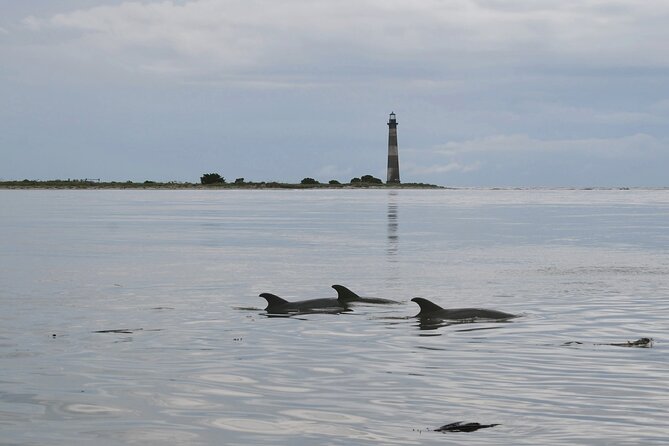
NOAA Fisheries' viewing guidelines for boats are specific, and we run by them. Stay at least 50 yards from dolphins, which is half a football field. Keep any one viewing to 30 minutes or less. Don't chase, circle or leapfrog them, and never trap them between the boat and the shore. Avoid sudden changes in speed or direction nearby. Never speed up toward a dolphin to throw a pressure wake for it to ride. If one comes to you, put the engine in neutral and let it pass.
"Always stay at least 50 yards away from dolphins (1/2 a football field) when viewing from watercraft."— NOAA Fisheries, Marine Life Viewing Guidelines
The law is one reason. The other is that I'd like the dolphins to still be here next year. NOAA lists what long-term disturbance costs them: poorer health, fewer calves, and animals pushed out of habitat they depend on. A boat that crowds dolphins every evening is working against the very thing its passengers came to see.
That covers you as well. Keep the snacks on the boat. Feeding a wild dolphin is illegal, SCDNR puts fines as high as $100,000, and the agency says feeding teaches dolphins to approach boats and docks, which raises their odds of being hit. A cracker over the rail counts.
What to expect on the water
I won't hand you a sighting percentage. I don't have one I'd stand behind. What you get every night is two hours on Charleston Harbor at the best light of the day, the Ravenel Bridge, Fort Sumter, the city skyline going gold, and a crew that's watching the water the whole way for you. Bring binoculars if you own a pair. They let you watch a group up close from 50 yards, which is where the boat should be anyway.
Sunset cruise or the daytime dolphin trip
For sunset color and a good shot at dolphins on the same evening, the sunset cruise is the trip. Seats are $59 for adults and $49 for kids 12 and under, plus 3% at checkout. It runs about two hours, nightly, timed to sunset, on the Roamer IV, which seats up to 23. The Roamer IV needs a 7-passenger minimum; with fewer than 7 total passengers, the cruise is assigned to a private watercraft. There's a bathroom aboard and life jackets for every age. BYOB is welcome for guests 21 and up, in cans or plastic with no glass on deck, and we bring the cooler, ice and cups. When you're ready, pick a date and book a seat on the sunset cruise.
If wildlife is the whole point of your day, look at our dolphin watching trip instead. It's a private boat for your group, about two hours, with morning and afternoon departures, and the route is built around the animals instead of the light. If you'd rather have the Roamer IV to yourselves at sunset, a private charter starts at $375 for the whole boat, up to 23 guests, on the same golden-hour route.
We leave from Shem Creek in Mount Pleasant, about a 14-minute drive across the Ravenel Bridge from downtown Charleston, with free public parking nearby. Get to the dock 15 minutes before your departure. Bring a light layer, because it cools about 10°F on the water at dusk, and wear flat or soft-soled shoes. We go rain or shine and cancel only for unsafe weather, with a full refund or a free reschedule, and cancellation is free up to 24 hours ahead. Questions about a date? Call (843) 874-8555.
Pricing, BYOB rules, weather policy, and departure details are all on our FAQ page — or call (843) 874-8555.
Frequently Asked
Will we see dolphins on a Charleston sunset cruise?
Sightings are common, but nobody can promise one. Bottlenose dolphins feed in Charleston Harbor at golden hour, and our sunset run is on the water for those two hours. They're wild animals, so some evenings they keep out of sight.
Are dolphins in Charleston Harbor year-round?
Yes. SCDNR describes South Carolina's bottlenose dolphins, an estimated several hundred animals, as year-round residents of nearshore coastal waters. There's no off season. Calm evenings just make them easier to spot.
How close does the boat get to the dolphins?
We follow NOAA Fisheries' guidelines: at least 50 yards, about half a football field, no chasing or circling, and 30 minutes or less with any one group. If a dolphin swims over to us on its own, we put the engine in neutral and let it pass.
What is strand feeding?
A hunting method Lowcountry dolphins use that SCDNR says is seen in only a few dolphin populations worldwide. A group herds fish onto the shoreline and the dolphins beach themselves for a moment to catch them. It happens on their schedule, so no trip can be planned around it.
Can we feed the dolphins or toss them scraps?
No. Feeding wild dolphins is illegal under federal law, and SCDNR notes fines can reach $100,000. Feeding teaches dolphins to approach boats and docks, which puts them at greater risk of being hit.
How much does a sunset dolphin cruise cost?
Shared seats are $59 per adult and $49 for kids 12 and under, plus 3% at checkout, for about two hours on the harbor. A private sunset charter for your group starts at $375 for the whole boat, up to 23 guests.
Local captain with LowCountry Coastal Excursions, running tours out of Shem Creek since 2017.