
A sand tiger shark tooth is a long, narrow crown with smooth cutting edges, one small curved cusplet on each side of its base and a deeply forked root. Check those in order, cusplets first, then edges, then the groove across the root, and you can tell it from a mako or a lemon shark tooth on the beach.
Sand tiger shark tooth identification gets a lot easier once you stop looking at the whole tooth and look at its base. That is where the two tiny side points sit, and on a worn beach find they are often the only thing standing between a sand tiger and a mako. This guide runs the checks in the order we would suggest for anyone shark tooth hunting near Charleston, with the Florida Museum of Natural History's fossil tooth key as the referee when two people disagree.
A few other posts sit behind this one. Our guide to identifying shark teeth by species covers the six sharks behind most Lowcountry finds, and if you are not yet sure the thing in your hand is a tooth at all, start with how to check whether a shark tooth is real. If you picked it up below the low-water line, read the Hobby License rules before it goes in your pocket.
What a sand tiger shark tooth looks like
Tall, thin and smooth. The Florida Museum's species profile describes sand tiger teeth as long, narrow main cusps with small lateral cusplets, and it counts 44 to 48 teeth in the upper jaw and 41 to 46 in the lower. Those cusplets are the little points on either side of the crown's base, and they are what you check first.
Hold the tooth root up and look straight at the flat face. The crown rises as a spike. Its two cutting edges are smooth, with no serrations anywhere, and on a front tooth they run almost parallel for much of the way to the tip. At the bottom of the crown, one small cusplet sits on each side, tucked right against the base. The key calls them not prominent and strongly curved, and that pairing is worth remembering.
Below that, the root splits into two lobes, like a pair of legs. Across the root runs a groove, which the key calls the transverse groove. You will need that groove later, because it is the check that survives when the cusplets do not.
Not every sand tiger tooth is the classic spike. The museum's guide to fossil shark teeth points out that the teeth near the middle of a shark's jaw are usually the largest, while the side teeth get smaller toward the corners of the mouth and change in shape and curvature as they go. A short, broader tooth with smooth edges and a cusplet on each side can still be a sand tiger. It just came from farther back in the jaw.
Run it through the Florida Museum key
The Florida Museum publishes a step-by-step key for the common genera of Neogene fossil shark teeth: pick between two statements, follow the one that fits, repeat. For a sand tiger the path is short, and walking it once teaches you more than any photo will.
- Is the tooth flattened front to back? Yes for a sand tiger.
- Single main cusp? Yes. The key counts teeth with small side cusplets as single-cusped.
- Are the cutting edges notched? No. Both edges run in a clean line.
- Serrated or smooth? Smooth.
- Lateral cusplets? Present, and the same number on each side.
- Where do they sit? Right against the base of the crown, with the cutting edge running unbroken.
- The root? A transverse groove is present, and on front teeth the edges run nearly parallel toward the tip.
- The cusplets themselves? Small rather than prominent, and strongly curved. That last answer lands on Carcharias taurus, the sand tiger.
The last fork is the one people skip. If the cusplets are prominent and not strongly curved, the key sends you to Odontaspis, a different genus of sand tiger shark: two or more pairs of cusplets with narrow, deeply arched root lobes points to Odontaspis ferox, the smalltooth sand tiger, and one pair of long cusplets with a broader root points to Odontaspis noronhai. So a slender tooth with side points is a sand tiger in the everyday sense, but the label on it depends on how big and how curved those points are.
One more caution about the key. It was built for Neogene teeth, from the Miocene and Pliocene. Charleston's older beds go back further. A Paleobiology paper on the fossil sharks and rays of the Florida Platform figures an Oligocene sand tiger tooth under the name Carcharias cuspidatus, next to Pliocene teeth of the living species. An old, black sand tiger-type tooth from a Charleston beach may belong to one of those extinct relatives rather than Carcharias taurus itself.
Sand tiger vs mako vs lemon shark tooth
Two teeth that get mistaken for a sand tiger on a Lowcountry beach are the mako, which is also smooth and slender, and the lemon shark, whose angled shoulders can pass for cusplets at a glance. The table puts them side by side with the smalltooth sand tiger, using the Florida Museum key for the features and our own species guide for sizes.
| Tooth | Side cusplets | Cutting edges | Root clue | Typical beach size | Key step |
|---|---|---|---|---|---|
| Sand tiger (Carcharias taurus) | One small, strongly curved cusplet each side | Smooth, unbroken; nearly parallel toward the tip on front teeth | Transverse groove present | Mostly under 0.75 in (19 mm) | 16a, 33b |
| Smalltooth sand tiger (Odontaspis ferox) | Two or more pairs, prominent | Smooth | Lobes deeply arched and narrow | No figure | 34a |
| Mako (Isurus) | None | Smooth | Groove absent or barely started; lobes not round | Up to 2 in (51 mm) | 16b, 32b |
| Lemon (Negaprion brevirostris) | None; the edges bend at angular notches instead | Smooth, sometimes with finely serrated shoulders | Root bulges on the tongue side | No figure | 3a, 12b or 29a |
The lemon is the trap for beginners. A cusplet is its own small point, sitting beside the crown. A lemon shark tooth has none. Its cutting edges bend sharply partway down and run out sideways as low shoulders, so the outline looks stepped, but the step is part of the blade itself. Run a fingernail down the edge: on a lemon it turns a corner and keeps going, while on a sand tiger it runs to the base and the cusplet stands apart from it.
The mako is the trap for everyone else. Cusplets are tiny and sit at the very edge of the crown, and a chipped or broken tooth may be missing them. Before you call a slender, smooth tooth a mako, look for a broken stub where a cusplet would have been. Then go to the root: on the key's sand tiger path the transverse groove is present, and on the mako path it is absent or barely started.
Is it a fossil or a modern tooth?
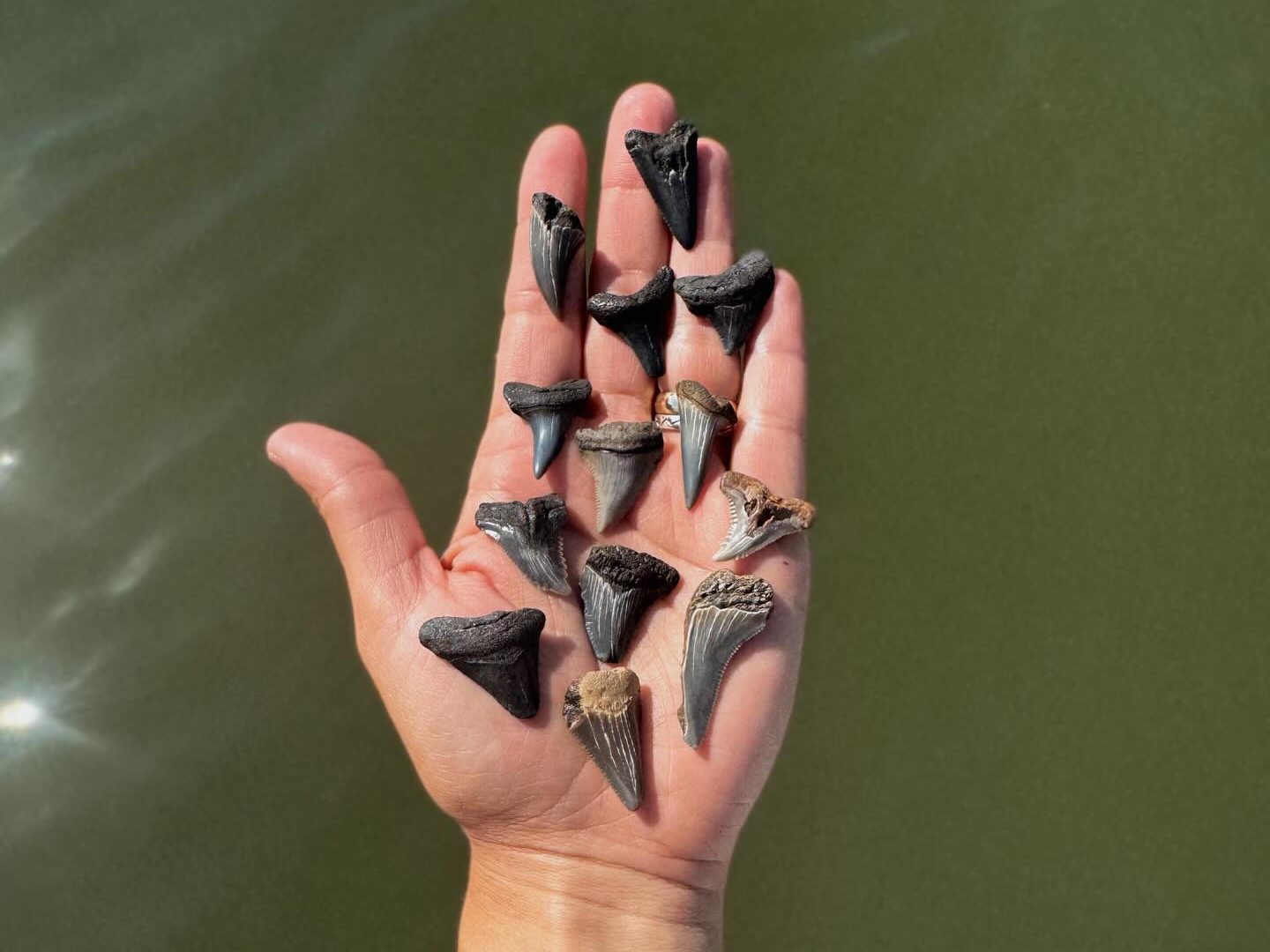
Look at the root. The Florida Museum explains that modern shark teeth are usually white in both crown and root, while a fossil tooth's root generally turns a darker grey or beige. The color of a fossil comes from the minerals in the sediment it was buried in, so it tells you about burial, not species.
That check matters for sand tigers because the species is still swimming off our coast. The museum's species profile puts its western Atlantic range from the Gulf of Maine to Argentina and says it moves toward the poles in summer and back toward the equator in fall and winter. A bright white sand tiger tooth with a white root on a South Carolina beach could easily be a recent one. Our species guide lists fossil sand tiger teeth as grey to tan, and our where-to-find guide says most beach finds read dark: black, gray, brown and sometimes tan.
You cannot put an age on a loose beach tooth by eye. It has washed out of whatever bed held it. The oldest fossil-rich layer in play under Charleston is the Ashley Formation, roughly 27 to 29 million years old, with the Chandler Bridge Formation at about 23 to 25 million above it and younger material reworked on top. The same naming argument that runs through our tiger shark tooth guide applies here: an old tooth with a living species' shape may still carry an extinct species' name.
Is the sand tiger shark endangered?
Yes. On the IUCN Red List the sand tiger shark, Carcharias taurus, is Critically Endangered under criteria A2bd, in a global assessment dated December 7, 2020 and published in 2021. The listing gives its population trend as decreasing and its generation length as 24.8 years.
Some references, the Florida Museum profile among them, still show the older Vulnerable listing, so check the date on any source you read. The biology explains why the species recovers slowly. The museum notes that a female produces two pups, one from each uterus, every other year; the largest embryo in each uterus eats the remaining eggs and smaller embryos before birth. In North American waters the sand tiger received full protection under the Atlantic Fishery Management Plan in 1997, and it is a prohibited species in the commercial longline shark fishery: any sand tiger caught has to be released.
None of that applies to a fossil tooth on the sand. The protections cover the living shark. A fossil tooth falls under South Carolina's collecting rules instead: one picked up from the exposed beach above the mean low water mark is yours to keep, unless you are on federal land such as a National Park Service site, where collecting is prohibited. Below that line, creek and river bottoms included, you need a license from the South Carolina Institute of Archaeology and Anthropology, which allows hand collection only.
Checking sand tiger teeth on a trip with us
Our shark tooth trips run by boat from Shem Creek in Mount Pleasant to barrier island beaches near Morris Island. We time departures around low tide, when the layer of shell and teeth is most exposed, and October through January is the best stretch of the year because the tides run lowest then, though we find teeth year-round. Sand tiger, mako, lemon and bull shark teeth are the four the tour page names as what you will be hunting for, with megalodon kept for lucky days.
The captain identifies every find on the spot. That is the fastest way to learn the cusplets: you see them on a real tooth in your own hand, next to a mako that has none.
"They were very knowledgeable and took time to show us real examples of what things we could find and where we should be looking."— Al T., Tripadvisor review shown on our shark tooth hunt page
The shared Morris Island trip is $125 per person for four hours. Departure times follow the tide, so check the booking calendar for your date. Your exact time is confirmed when you book. If you would rather have the boat to yourselves, the private Shark Tooth & Sea Shell Hunt runs three hours from $400 for one or two guests, plus $50 for each extra guest up to 12. Fees and taxes of 3% are added at checkout, and cancellation is free up to 24 hours ahead.
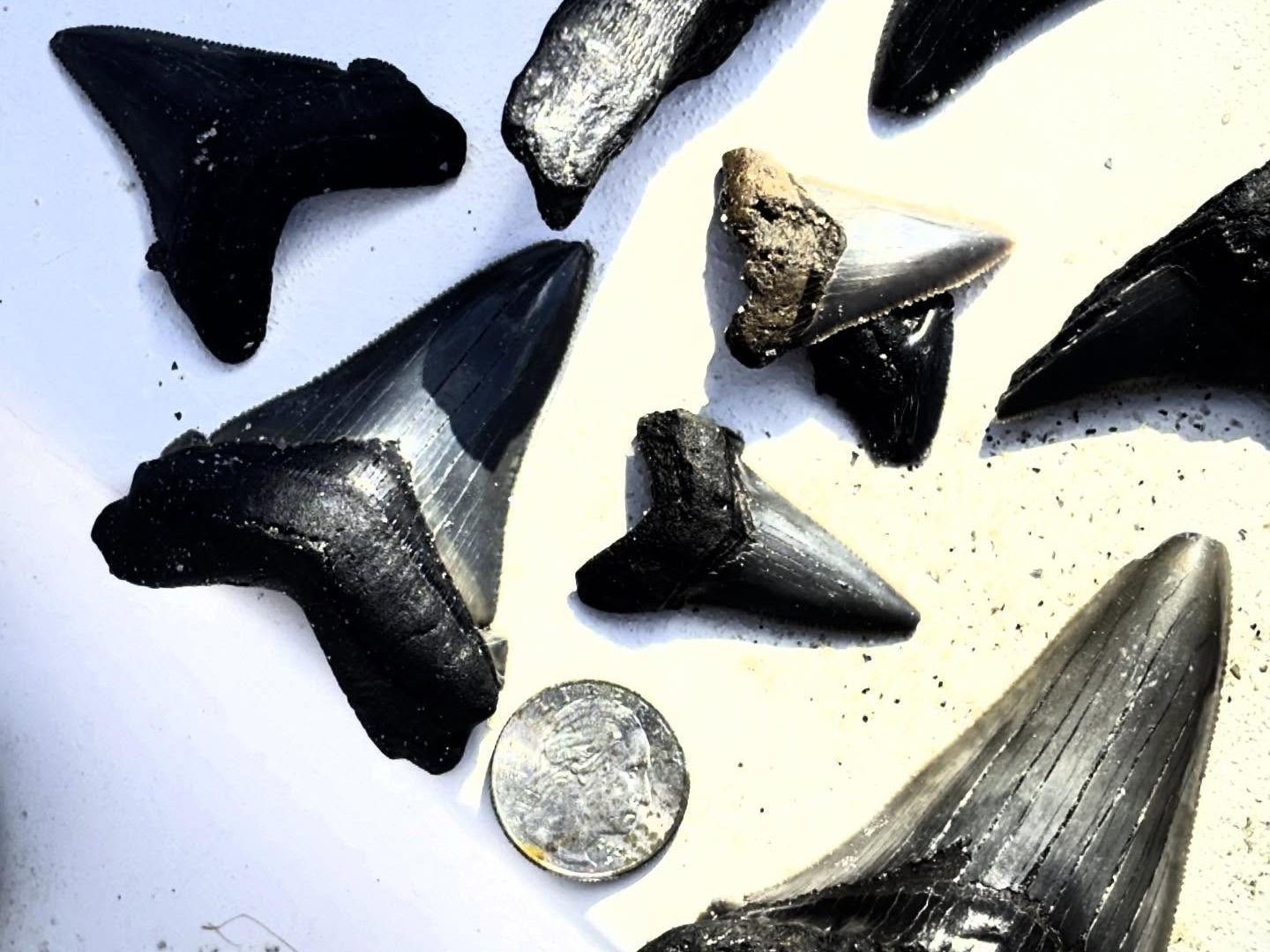
Here is the 30-second check to run on any slender, smooth tooth you pick up:
- Base of the crown: one small cusplet on each side, curving inward? That says sand tiger.
- No cusplets: look for a broken stub before you settle on mako.
- Edges that turn a sharp corner into low shoulders: that is a lemon, not a sand tiger.
- Cusplets large, straight or doubled: check for Odontaspis.
- Root: a groove across the middle favors sand tiger over mako.
- Root color: white crown and white root, probably modern. Dark root, probably fossil.
Pricing, BYOB rules, weather policy, and departure details are all on our FAQ page — or call (843) 874-8555.
Frequently Asked
What does a sand tiger shark tooth look like?
A sand tiger shark tooth is a long, narrow spike with smooth cutting edges, one small curved cusplet on each side of its base and a root split into two lobes. Front teeth are the most slender; teeth from farther back in the jaw are shorter and broader but keep the cusplets.
How do you tell a sand tiger tooth from a mako tooth?
Check the base and the root. A sand tiger has a small cusplet on each side of the crown and a groove across the root, while a mako has no cusplets and the groove is absent or barely started. A chipped sand tiger can be missing its cusplets, so look for broken stubs.
How big are sand tiger shark teeth?
On Lowcountry beaches, mostly under three-quarters of an inch (about 19 mm), according to our species guide. Front teeth from the middle of the jaw are usually the largest, and the side teeth get smaller toward the corners of the mouth.
Is the sand tiger shark endangered?
Yes. The IUCN Red List lists the sand tiger shark as Critically Endangered under criteria A2bd, in a global assessment dated December 7, 2020 and published in 2021, with a decreasing population. Some older references still show its earlier Vulnerable status.
Is a white sand tiger tooth a fossil?
Probably not. The Florida Museum notes that modern shark teeth are usually white in both crown and root, while fossil roots turn darker grey or beige. Sand tigers still live along the western Atlantic coast, so a white tooth on a South Carolina beach may be recent.
Can I keep a sand tiger tooth I find in South Carolina?
Yes, if you picked it up from the exposed beach above the mean low water mark and you are not on federal land such as a National Park Service site, where collecting is prohibited. Below that line, including creek and river bottoms, you need a Hobby License from the South Carolina Institute of Archaeology and Anthropology, which allows hand collection only.
Local captain with LowCountry Coastal Excursions, running tours out of Shem Creek since 2017.