
Charleston Shark Teeth Hunting, which runs Morris Island trips from Shem Creek in Mount Pleasant, puts it simply: a tiger shark tooth is a flat blade whose tip leans hard to one side, with a deep notch on the rear edge and serrated edges whose serrations are serrated again, so the outline looks like a rooster's comb.
A tiger shark tooth is one of the easiest teeth on a Lowcountry beach to name once you know the one thing to look for, and the easiest to talk yourself out of when it is small and worn. The thing to look for is the notch, and our species guide puts it plainly: once you have seen one, you will never miss another. Everything below, the serrations, the root, the color and the fossil relatives with their disputed names, is there to confirm what the notch already told you.
Key takeaways
- The notch is the tell. The Florida Museum of Natural History describes each tiger shark tooth as having a deep notch on its outer margin, lined with small cusplets.
- The edges are finely serrated, and on the living species the serrations carry smaller serrations of their own, one of the characters a 2021 study used to separate tiger shark species.
- Upper and lower teeth of the living tiger shark look alike, so you rarely need to know where in the jaw a tooth sat to call it a tiger.
- Charleston's Oligocene tiger-type teeth include some tiny ones. A study of the Chandler Bridge Formation at Summerville recorded a Physogaleus that may be a new species, its largest broken tooth estimated at about 8 mm across.
- Color tells you about burial, not species. A tooth that is white in crown and root is usually modern; a darker root usually points to a fossil.
Start with the notch
Hold the tooth with the root down and the point up. On a tiger shark tooth the crown leans hard to one side, and the edge facing the front of the jaw is long and curved, running in one sweep from the root to the tip.
The other edge is where the identification happens. A short way down from the tip it drops into a deep notch, then runs out along a low, sloping shoulder toward the root. The Florida Museum of Natural History's tiger shark profile describes exactly this: a deep notch on the outer margin lined with numerous cusplets. Those cusplets along the shoulder, which paleontologists call the distal heel, are what give the tooth its rooster-comb outline.
"Each tooth has a deep notch on the outer margin lined with numerous cusplets."— Florida Museum of Natural History, Discover Fishes: Tiger Shark
Check the notch before anything else, because it is part of the outline rather than the surface. Surf wear can soften fine edge detail until a serrated tooth starts to look smooth. A notch is a change in the shape of the tooth itself, so look for the step in the rear edge even on a tooth whose edges have gone dull.
Serrations on the serrations
The second check needs good light or a hand lens. Both cutting edges of a tiger shark tooth are serrated, and on the living species, Galeocerdo cuvier, the larger serrations carry smaller serrations of their own. Our guide to identifying shark teeth by species says the double serration shows with the naked eye if you turn the tooth against the light. Dry it first; a film of seawater hides fine relief.
That double serration is more than a field trick. In a 2021 study in Paleobiology, Julia Türtscher and colleagues at the University of Vienna analyzed the outlines of 569 teeth, living and fossil, and paired the shapes with tooth characters such as serration type. They describe the living tiger shark and the Pliocene species Galeocerdo capellini as having secondary serration, while the long-lived extinct species Galeocerdo aduncus has single serrations. So the tiny teeth-on-teeth you see under the light help separate a modern-type tiger tooth from Galeocerdo aduncus. It is not a universal rule: the same paper credits compound serrations to an Eocene species, Galeocerdo clarkensis, as well.
Upper, lower, front or side
Jaw position can complicate shark tooth identification, because upper and lower teeth from one animal do not always match. The tiger shark makes this easier. Türtscher's team calls the living species exceptional because the teeth of both jaws are very similar in appearance. What does change is position along the jaw: front teeth and side teeth differ in shape, which paleontologists call monognathic heterodonty.
So two tiger teeth from different parts of the same mouth can differ in proportion, one taller and one wider, and you still do not need to place them in the jaw to call them tiger shark. Each should carry the notch and the serrated heel behind it.
The older members of the lineage are not so tidy. In Oligocene teeth from the Chandler Bridge Formation near Summerville, David Cicimurri and James Knight recorded two tooth forms traditionally identified as Galeocerdo contortus and Galeocerdo aduncus, which earlier studies of the Atlantic Coastal Plain found together in nearly equal numbers. One interpretation they cite treats the contortus form as the lower teeth of males. That disagreement matters for the name on your label, and it comes up again below.
Tiger shark tooth vs snaggletooth vs great white
Three teeth are worth ruling out before you call a find a tiger: a small, worn snaggletooth, an extinct tiger-type tooth from the older beds, and a small serrated triangle somebody hopes is a great white. The table lines them up. Each figure comes from the source named in the row, and where the figure is ours, the row says so.
| Tooth | Outline | Serrations | Size | Source |
|---|---|---|---|---|
| Tiger shark (Galeocerdo cuvier) | Crown leans to one side; deep notch on the rear edge; cusplets on the heel | Fine, with smaller serrations on the serrations | Usually under 1 in (25 mm) on Lowcountry beaches | Florida Museum; Türtscher et al. 2021; our species guide |
| Extinct tiger-type (Galeocerdo aduncus or Physogaleus) | Same notched plan | Single serrations (G. aduncus) | Chandler Bridge Physogaleus sp.: largest estimated about 8 mm (0.3 in) wide | Türtscher et al. 2021; Cicimurri and Knight 2009 |
| Snaggletooth (Hemipristis serra) | Hooked and asymmetric, no serrated heel behind a notch | Coarse, upper edge only | Up to about 1.5 in (38 mm) | Our species guide |
| Great white (Carcharodon carcharias) | Upright broad triangle, no notch | Coarse, both edges | First upper front crown 14.5 mm (1.65 m shark) to 48.8 mm (5.94 m shark) | Shimada 2002, via our great white guide |
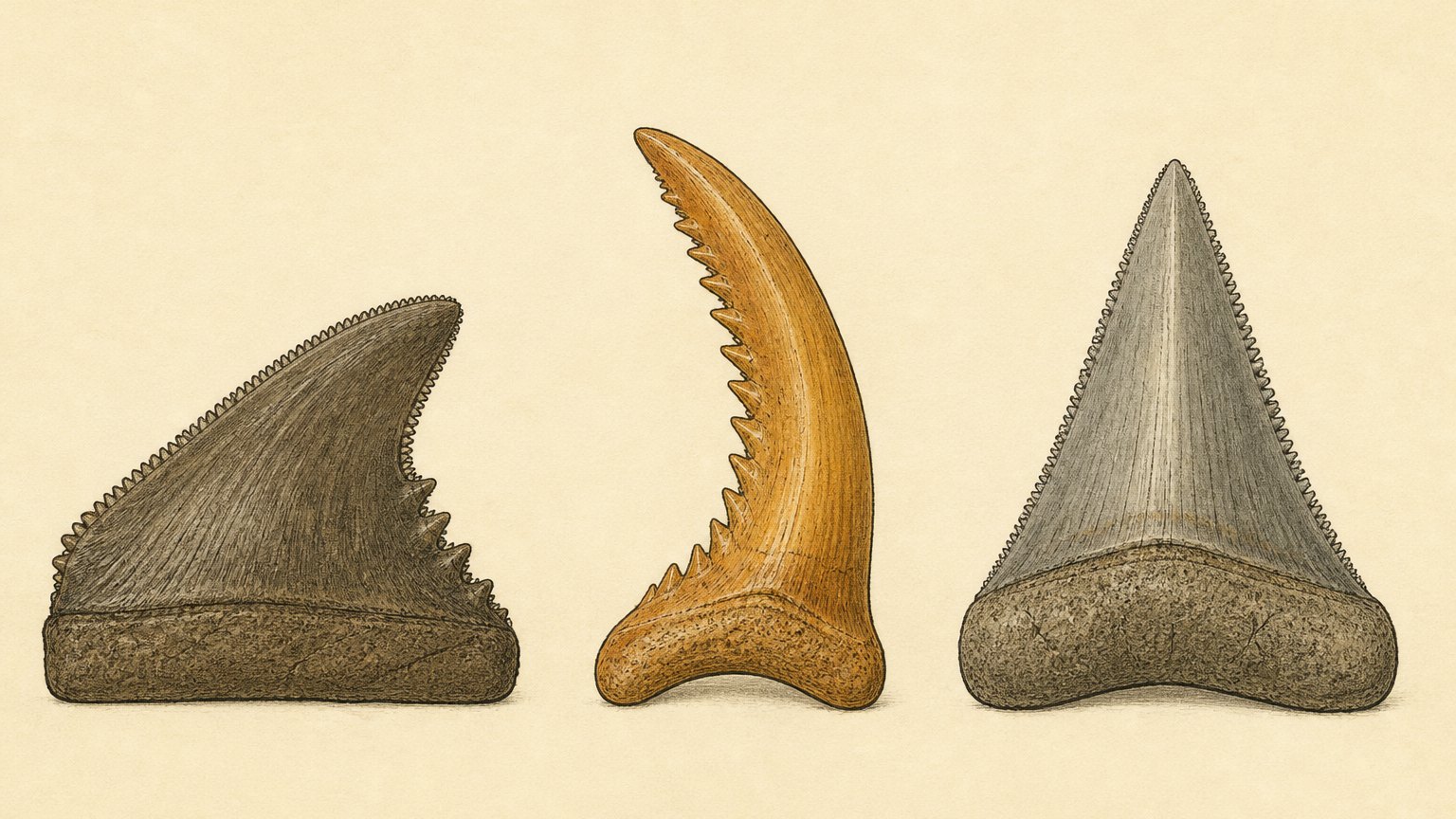
The snaggletooth is the hard one. Hemipristis serra is on the Chandler Bridge species list too, its crown is hooked, and a worn one can pass for a tiger at a glance. Our species guide gives the quickest separation: the snaggletooth's coarse serrations run along one edge and stop. There is no notch and no serrated heel behind them, either.
The great white is easier. Its crown stands upright as a broad triangle with no notch at all, and our great white guide walks through the edge and root checks that separate it from its own look-alikes. If a tooth is a symmetrical triangle, it is not a tiger, however serrated it is.
How big is a tiger shark tooth?
Small, on a South Carolina beach. Our species guide puts a typical Lowcountry tiger shark tooth at under an inch, and one older local relative is far smaller: the largest Physogaleus sp. tooth in a Summerville sample was estimated at about 8 mm across.
The living animal is not small. The Florida Museum says tiger sharks commonly reach 10 to 14 feet, with the largest over 18 feet, and lists a diet that takes in sea turtles, rays, other sharks, bony fish, sea birds and carrion. It also notes the tiger shark is the third most common large coastal shark caught in the United States, which is a statement about fisheries, not about what turns up in a beach sifter.
The Summerville figure deserves a second look, because of how it was found. The Chandler Bridge teeth were recovered by soaking bulk sediment, more than 50 kilograms of it at one museum, and washing it through screens as fine as 0.25 millimeter before sorting the residue under a microscope. That is a different search entirely from scanning shell hash at your feet, and a reason the smallest tiger-type teeth from those old beds are easy to walk past.
Fossil tiger shark teeth and the argument over their names
Find a fossil tooth with a tiger's notch near Charleston and the honest label may carry a question mark. It could be the living tiger shark, an extinct Galeocerdo, or a relative whose genus depends on which paper you follow.
Türtscher's team traced the genus Galeocerdo back to the early Eocene, roughly 56 to 48 million years ago. Of the 23 species previously recognized, they found support for only six, the living tiger shark among them. They also extended the living species back to the middle Miocene, about 13.8 million years ago, on the strength of 37 teeth from middle Miocene deposits in Florida.
Cicimurri and Knight handled the Summerville teeth differently. Following Ward and Bonavia, they filed both tooth forms under Physogaleus, a related genus, as Physogaleus aduncus, alongside a second, unnamed Physogaleus that they say appears to represent a new species. Other researchers kept the aduncus form in Galeocerdo, and the 2021 revision lists Galeocerdo aduncus as a valid species from the Oligocene into the late Miocene.
For a collector, the upshot is practical. A larger fossil tooth with serrations on its serrations, from middle Miocene or younger ground, is a candidate for the living species or its Pliocene relative, Galeocerdo capellini. A small, older tooth with simple serrations may be called Galeocerdo aduncus in one paper and Physogaleus in another. Neither label is wrong the way calling a mako a tiger is wrong; they reflect an argument that is not settled.
Modern or fossil: read the root
A tiger tooth's color tells you nothing about the species and a good deal about its history. The Florida Museum explains that the color of fossil shark teeth comes from the minerals in the surrounding sediment. It also gives the simplest modern-or-fossil check: modern teeth are typically white in both crown and root, while a fossil can keep a white crown but its root is usually a darker grey or beige.
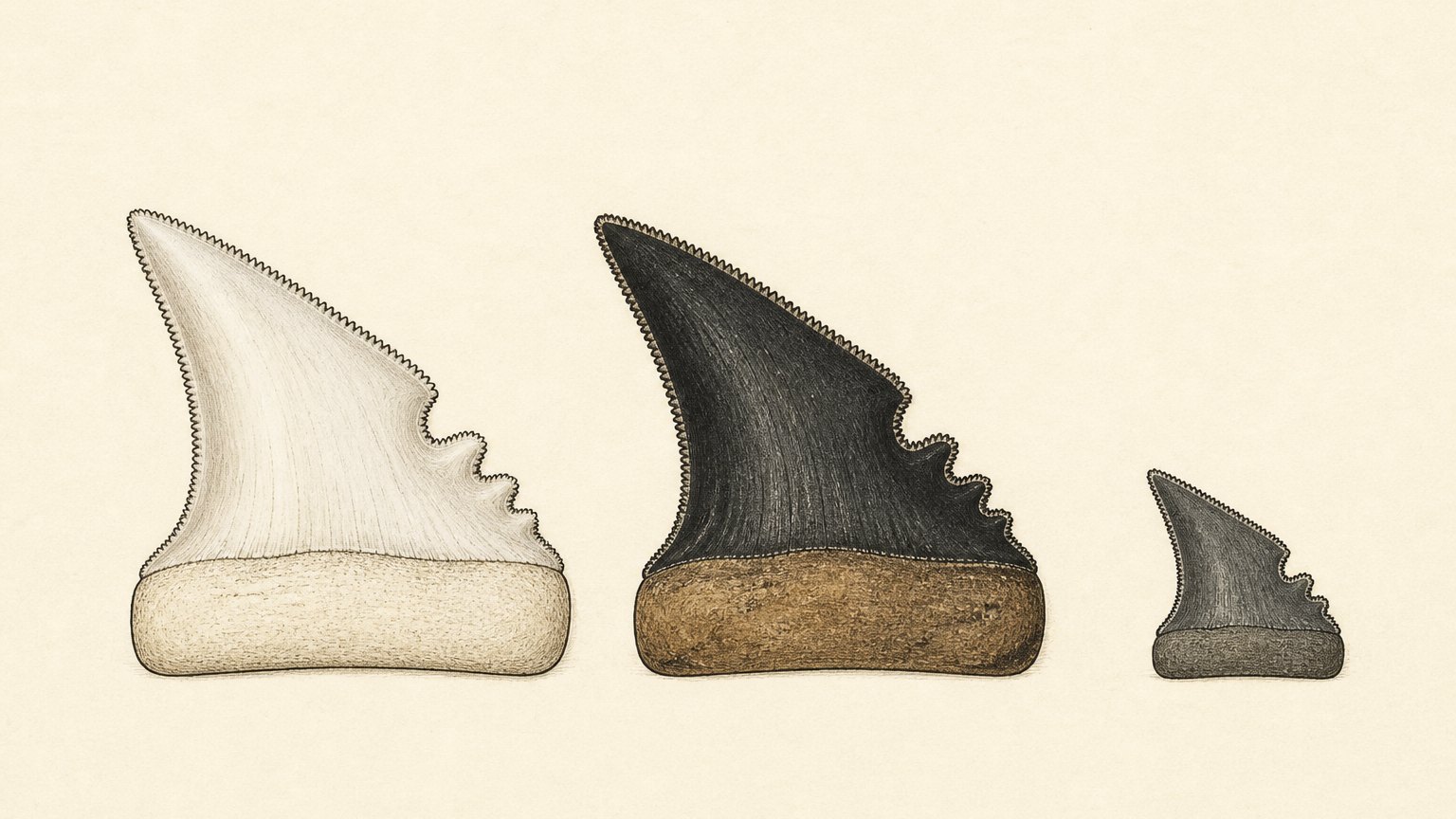
Our Charleston guide describes most local finds as dark gray, black or tan, which is what you should expect of a fossil tiger tooth here. A bright white tiger tooth with a white root is most likely a modern shed tooth.
Then the age question. A tooth on a beach has been washed out of whatever bed held it, so it cannot be dated by eye. What the lineage gives you is a range. If the Paleobiology dates hold, a tooth of the living species is no older than the middle Miocene, about 13.8 million years. Charleston's well-known Oligocene beds, the Ashley and Chandler Bridge formations, are older than that, so a tiger-type tooth out of those beds belongs to the older relatives, not the living tiger shark.
Checking one on the beach
Our shark tooth hunting trips run by boat to the barrier island beaches around Morris Island, and the tour page says every departure is timed around low tide, when the tooth layer is most exposed. The shared boat leaves in the morning, around 8:00 AM depending on the tide, and the tour page names October through January as the best season, when tides run lowest, though we find teeth year-round.
Be straight with yourself about the odds. The tour page's list of what you will hunt for names sand tiger, mako, lemon and bull shark teeth, and it does not name the tiger shark. Our species guide does include the tiger among the six sharks it covers for the Lowcountry. A tiger tooth is a find to hope for and check carefully, not one we promise.
Here is the 30-second check, in the order we would run it:
- Root down, point up: does the crown lean hard to one side?
- Rear edge: is there a deep notch with a short, serrated shoulder below it?
- Edges: turned against the light and dry, do the serrations carry smaller serrations?
- Outline: if it is an upright symmetrical triangle, or hooked with serrations on one edge only, it is not a tiger.
- Root color: white crown and white root usually means modern; a darker root usually means fossil.
On the sand, the captain identifies every find on the spot, which is the quickest way to learn the notch: you see it on a real tooth in your hand, next to the sand tiger and mako teeth it is not. A tooth picked up from the exposed beach above the mean low water mark is yours to keep. Collecting below that line, creeks and rivers included, needs a Hobby License from the South Carolina Institute of Archaeology and Anthropology, and it allows hand collection only. The shared boat is $125 per person, and you keep every tooth you find.
Pricing, BYOB rules, weather policy, and departure details are all on our FAQ page — or call (843) 874-8555.
Frequently Asked
How do you identify a tiger shark tooth?
Look for the notch. A tiger shark tooth has a crown that leans hard to one side, a deep notch on its rear edge with small serrated cusplets on the shoulder below it, and finely serrated edges whose serrations carry smaller serrations of their own.
How big are tiger shark teeth?
Small on a South Carolina beach: our species guide puts typical Lowcountry finds at under an inch. Some older local relatives are smaller still: the largest tooth of an Oligocene Physogaleus sp. from Summerville was estimated at about 8 mm across.
Are tiger shark teeth rare?
We would not promise one. Our species guide includes the tiger shark among the six sharks it covers for the Lowcountry, but our tour page's list of what you will hunt for does not name it, so treat a tiger tooth as a good find and check it carefully.
What is a fossil tiger shark tooth?
A tooth from the tiger shark lineage, Galeocerdo, that was buried and mineralized. The genus goes back to the early Eocene, and a 2021 Paleobiology revision recognizes six valid species, including the living tiger shark, Galeocerdo cuvier.
How old is a fossil tiger shark tooth?
It depends on the species. The living tiger shark's fossil record reaches back about 13.8 million years, to the middle Miocene, while the extinct Galeocerdo aduncus runs from the Oligocene into the late Miocene. A loose beach find can only be given a range.
What is the difference between a tiger shark tooth and a snaggletooth?
The notch and the serrations. A tiger shark tooth has a deep rear notch with a serrated shoulder and serrations on both edges. A snaggletooth, Hemipristis, is hooked, with coarse serrations along one edge only and no serrated heel behind a notch.
How can you tell a modern tiger shark tooth from a fossil?
Check the root. The Florida Museum notes that modern shark teeth are typically white in both crown and root, while fossil teeth usually have a darker grey or beige root. Our Charleston guide describes most local finds as dark gray, black or tan.
Local captain with LowCountry Coastal Excursions, running tours out of Shem Creek since 2017.