
Charleston Shark Teeth Hunting, the Morris Island trips LowCountry Coastal Excursions runs from Mount Pleasant, explains it simply: a fossil shark tooth is a tooth shed millions of years ago, buried in seafloor sediment and slowly filled with minerals from it. Minerals from that sediment, such as iron and manganese, set the color, and most finds around Charleston are dark gray, black or tan.
A fossil shark tooth is a tooth a shark shed millions of years ago that sank, was buried in seafloor sediment, and spent its burial taking up minerals from that sediment. The minerals are why it is dark and heavy. The sediment is also the only reliable clock: the tooth tells you what shark it came from, and the bed it came out of tells you when. That second half is the part that is easiest to get backwards, so it gets most of this guide.
Key takeaways
- A tooth becomes a fossil by permineralization: groundwater moving through the sediment leaves minerals in the tooth's pore spaces, according to the Florida Museum of Natural History.
- There is no fixed fossilization time. The Florida Museum says the process usually takes thousands of years, and its collection manager describes the crystal changes running over hundreds to a few thousand years.
- Color comes from minerals in the burial sediment, not the species or the age. Our own Charleston guide describes most local finds as dark gray, black or tan.
- Age comes from the bed. The USGS dates the Ashley and Chandler Bridge formations under the Summerville area to about 30 and 28 million years, both in the Oligocene.
- A black megalodon tooth is black for the same reason as any other, and it is no younger than about 3.6 million years, when the species went extinct.
What turns a shed tooth into a fossil
The Florida Museum notes that a shark can shed many thousands of teeth in its lifetime, and that a tooth must sink and be quickly covered by sediment to fossilize. A tooth that stays on an open seafloor gets rolled, scraped and broken. The ones that last are the ones that get covered quickly. The Florida Museum of Natural History, explaining how shark teeth become fossilized, says rapid burial matters because sediment protects the tooth from weathering, abrasion and scavenging, and because burial limits its exposure to oxygen and the bacteria that cause decay.
Then the slow part starts. Water seeps down through the sediment and over the buried tooth, carrying dissolved minerals, and those minerals are deposited into the open pore spaces inside it. That is permineralization. The museum names silica and calcite as the most common minerals, with whatever local minerals the sediment holds added on top.
One detail changes how you should look at the tooth in your hand. A shark tooth is not uniform. Richard Hulbert, the Florida Museum's vertebrate paleontology collection manager, explains that the thin enamel layer on the crown starts out as nearly 100% mineral, so it is altered less than the root and dentin underneath. That is why the glossy blade and the duller root of a fossil tooth are often two different colors. His conclusion: the teeth are true fossils, but they have not been 100% replaced with new minerals.
"The best way to determine the age of fossil shark teeth is to determine the age of the sediments that the teeth were found in."— Florida Museum of Natural History, Fossil Shark Teeth
How long fossilization takes
Shorter than people expect, and much shorter than the age of the teeth we find. The Florida Museum says the process usually takes thousands of years. Hulbert puts the key chemical stage, when the arrangement of atoms in the tooth's crystals shifts into a more stable pattern and some calcium is swapped for iron, manganese and other elements, at hundreds to a few thousand years.
So the speed of fossilization is not what makes a Lowcountry tooth old. Once a tooth has taken up its minerals it can sit in the bed for millions of years more, get eroded out, reburied, and eroded out again. A tooth that fossilized in a few thousand years can be tens of millions of years old by the time it reaches the shell line. The two numbers measure different things, and only the second one is worth asking about.
Why Charleston teeth come out black
Color is borrowed from the burial. The Florida Museum explains that as minerals fill a tooth they react with trace amounts of oxygen and take on different colors, the way iron rusts reddish brown, and that teeth turn up in blue-grey, black, orange-red, white and green depending on what the sediment carried. Hulbert adds that the color change comes from iron, manganese and other elements taking the place of calcium.
Now look at what the ground here is made of. A USGS geologic map of the Summerville area describes the Ashley Formation as a phosphatic calcarenite and the Chandler Bridge Formation above it as quartz and phosphate sands. The same report notes that phosphate rock was mined extensively near Charleston from 1867 to 1937, from a lag bed at the base of the much younger Wando Formation. Neither the report nor the Florida Museum ties tooth color to phosphate itself; the museum credits the minerals in the sediment, and Hulbert names iron and manganese. What we can report is what our own Charleston guide says about local finds: most are dark gray, black or tan.
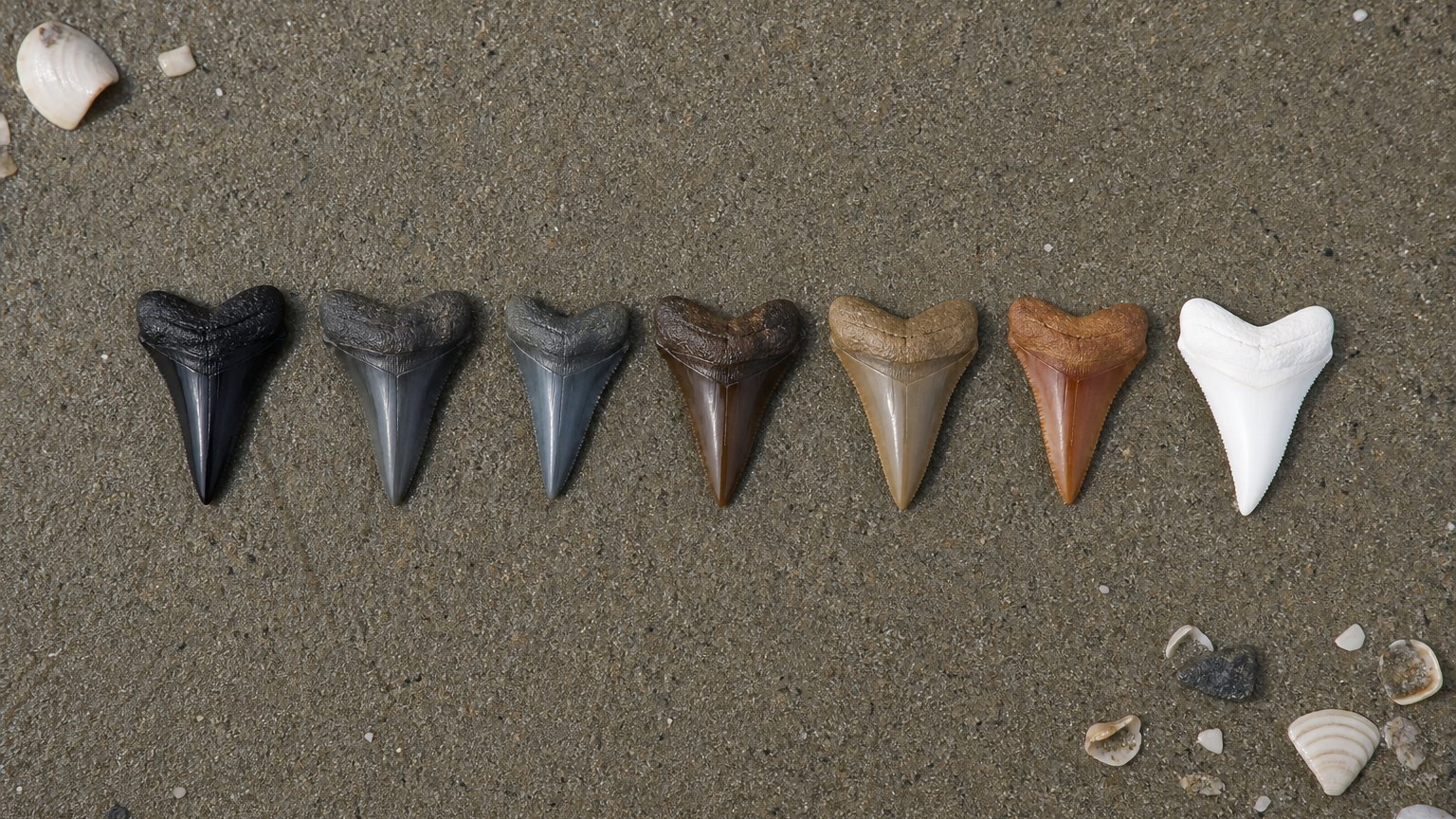
Two things follow. First, black is not a grade. A jet-black tooth is not older, rarer or more real than a brown one from the same species; it was buried in different chemistry. Second, color is a poor species clue. The same shark can leave teeth in three colors if they settled in three different sediments. If you want to know which shark you have, that is a shape question, and our guide to identifying shark teeth by species walks through it tooth by tooth.
How old is yours: the bed, not the tooth
Here the Florida Museum is blunt. Sharks are poor indicators of geologic age because they evolve slowly, and many species living today have been around for 4 to 5 million years. The way to date a fossil tooth is to date the sediment it came from, using geologic maps or the faster-evolving fossils found alongside it.
That is a problem on a beach, because a beach is not a bed. The teeth on a barrier island shell line have been worked out of older deposits by waves and currents and mixed together. On Morris Island you can pick up two teeth side by side that were buried millions of years apart. What you can do is know which beds feed this coast, and what ages the geologists put on them.
| Epoch | Epoch span (million years ago) | Charleston-area unit (USGS) | Unit age (million years) |
|---|---|---|---|
| Oligocene | 33.9 to 23.03 | Ashley Formation, phosphatic calcarenite | About 30 |
| Oligocene | 33.9 to 23.03 | Chandler Bridge Formation, quartz and phosphate sands | About 28 |
| Latest Oligocene or earliest Miocene | Boundary at 23.03 | Edisto Formation, phosphatic shelly sands | About 24 |
| Miocene | 23.03 to 5.332 | Marks Head Formation (early Miocene) and Rudd Branch beds | Not dated to a single figure |
| Pliocene | 5.332 to 2.588 | Goose Creek Limestone and Raysor Formation | Not dated to a single figure |
| Pleistocene | 2.588 to 0.0117 | Wando Formation, with the phosphate lag bed at its base | Late Pleistocene |
Read the table from the top and the Lowcountry story falls out of it. The oldest units in the table are Oligocene, from a sea that covered this area around 30 million years ago, and the report calls the Chandler Bridge one of the most prolific bone-producing units in the Charleston region. Younger Miocene, Pliocene and Pleistocene beds were laid over them, eroded, and in places stripped away. The USGS time scale fixes the epoch boundaries the ages hang on: the Oligocene runs from 33.9 to 23.03 million years ago, the Miocene to 5.332, the Pliocene to 2.588.
The practical answer, then, is a range. A fossil tooth from a Charleston beach could come from any bed in that table, from the late Pleistocene Wando back to the roughly 30-million-year-old Ashley, and the species narrows it. A tooth from a shark that only lived in the Oligocene came out of the old beds. A tooth from a species still swimming today could be almost any age in that range.
The black megalodon tooth
The tooth people hope for is a black megalodon, and it gets the same treatment as any other. Its color is burial chemistry. Its age has a hard floor, though, because the species is gone. A 2019 study in PeerJ by Robert Boessenecker and colleagues reviewed the late megalodon records, threw out the reworked ones, and put the extinction at about 3.6 million years ago, in the Pliocene. The same paper describes megalodon as a Neogene shark, the stretch of time that begins with the Miocene.
So a black megalodon tooth from around here is no younger than about 3.6 million years and no older than the start of the Miocene, roughly 23 million years ago on the USGS scale. That also means a megalodon tooth was never buried in a 30-million-year-old Oligocene bed in the first place. The big triangular tooth that does come out of the Oligocene here belongs to an older relative, Otodus angustidens, which carries small side cusplets that megalodon lost. Telling the two apart is a species call, covered in our identification guide.
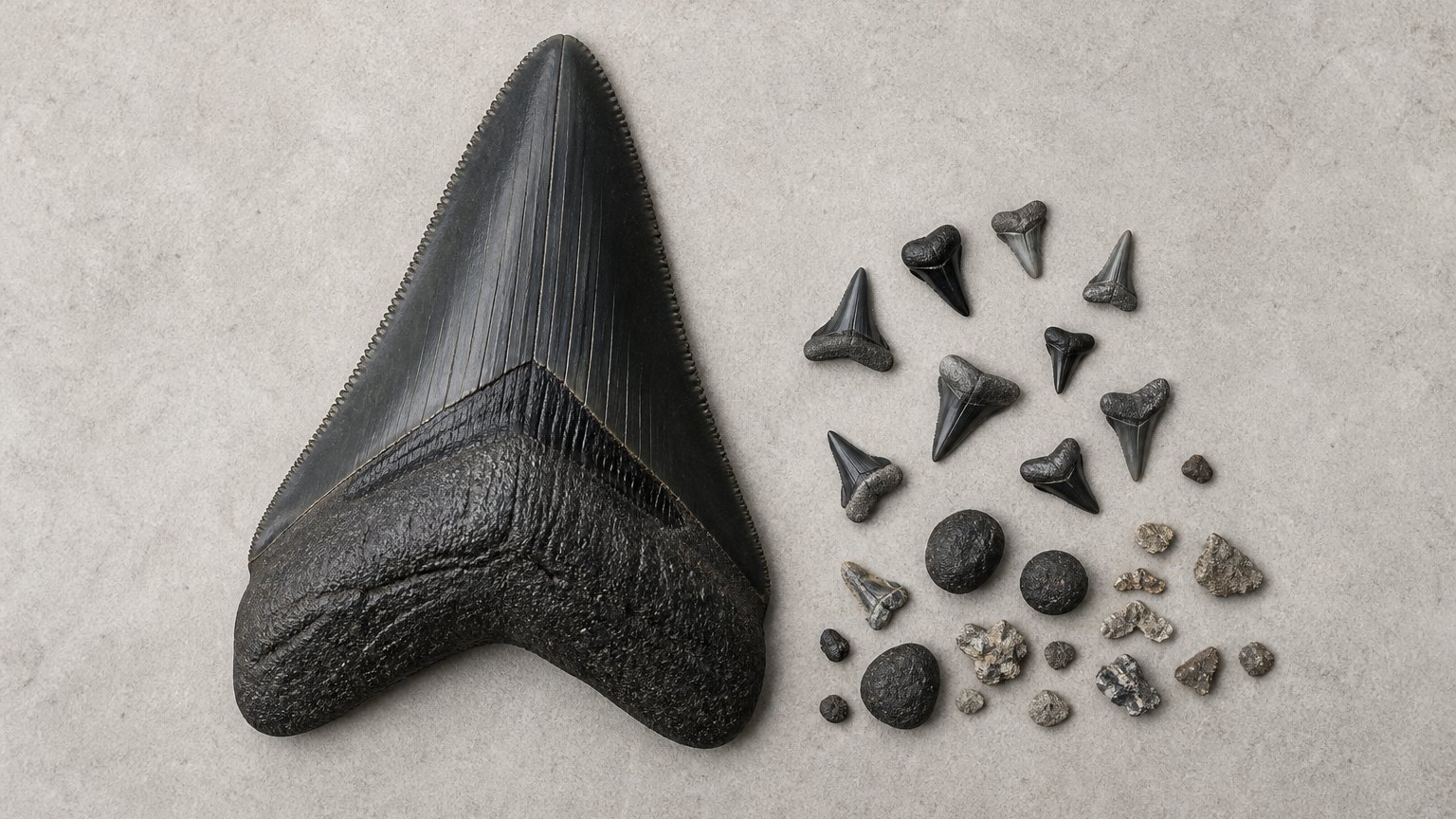
One more note on size, since a palm-sized black tooth is what the photos show. Our Charleston guide puts most finds at a quarter-inch to an inch, and a complete large tooth is a good day rather than an expected one.
Fossil, modern or fake: three quick checks
Ask three questions, in this order.
- Look at the root. The Florida Museum notes that modern teeth are typically white in both the crown and the root. Fossil teeth can sometimes keep a pale crown, but the root is usually darker grey or beige. A dark root on a pale blade still reads fossil.
- Ask where it was found. The museum's own example: a tooth from a creek 50 miles from the nearest ocean is safe to call a fossil. On a beach, where modern teeth also wash in, the root color does more of the work.
- Check it has a blade and a root at all. A black shell chip or a phosphate pebble can look like a tooth from standing height but is one material all the way through.
Fakes are a separate problem from fossils. If you bought a tooth or were handed one and want to know whether a shark tooth is real, the replica checks are in our separate guide.
What to do with a tooth you found
Start by writing down where and when you found it, before it goes in a jar with forty others. The Florida Museum's whole method for dating teeth runs through the location and the sediment, and it suggests keeping the other fossils that turn up alongside, because faster-evolving animals date a deposit better than sharks do. A beach find will never be precisely dated, but a labeled one can at least be compared.
Then sort by shape, not color. Group the needle-thin teeth, the smooth blades, the serrated triangles and the hooked ones; that is how species fall out. Keep anything you cannot place in its own pile rather than forcing it into one. And if you picked it up on the exposed beach, it is generally yours to keep: South Carolina's licensing rules for fossils apply below the mean low tide line, and our collecting-laws guide covers what changes there.
Seeing them come out of the shell hash
Reading a tooth is easier with the bed it came from in front of you. Our shark tooth hunting trips run by boat to the barrier island beaches around Morris Island, and the tour page says every departure is timed around low tide, when the tooth layer is most exposed. The captain teaches sifting on the sand and identifies every find on the spot, which is the fastest way to learn the difference between a phosphate pebble and a worn tooth. The shared boat is $125 per person, and you keep every tooth you find.
Pricing, BYOB rules, weather policy, and departure details are all on our FAQ page — or call (843) 874-8555.
Frequently Asked
What is a fossil shark tooth?
A tooth a shark shed long ago that was buried in seafloor sediment and filled with minerals carried by groundwater, a process called permineralization. Our Charleston guide describes most local finds as dark gray, black or tan, and they come from beds the USGS dates to the Oligocene and later epochs.
How long does a shark tooth take to fossilize?
Usually thousands of years, according to the Florida Museum of Natural History, and its collection manager puts the key crystal changes at hundreds to a few thousand years. That is far shorter than the age of the fossil teeth found around Charleston, which then sit in their beds for millions of years.
Why are shark teeth black?
Because of the sediment they were buried in. Minerals such as iron and manganese replace some of the tooth's calcium and change its color. Our Charleston guide describes most local finds as dark gray, black or tan. Black does not mean older, rarer or a different species.
How old are Charleston shark teeth?
It depends on the bed. The USGS dates the Ashley and Chandler Bridge formations near Summerville to about 30 and 28 million years, in the Oligocene, with younger Miocene, Pliocene and Pleistocene beds above. A beach tooth can come from any of them, so it is usually given as a range.
How old is a black megalodon tooth?
No younger than about 3.6 million years, when a 2019 PeerJ study by Boessenecker and colleagues places the extinction, and no older than the start of the Miocene, about 23 million years ago. The black color comes from burial chemistry, not age.
How can you tell a fossil shark tooth from a modern one?
Check the root. Modern shark teeth are typically white in both crown and root, the Florida Museum notes, while fossil teeth usually have a darker grey or beige root even when the crown stays pale. Where it was found helps too: the museum says a tooth from a creek 50 miles from the nearest ocean is safe to assume is a fossil.
Can you date a single shark tooth?
Not precisely. The Florida Museum says sharks evolve too slowly to date rocks well, and many living species are 4 to 5 million years old. The reliable way is to date the sediment the tooth came from, which a beach find has already left behind.
Local captain with LowCountry Coastal Excursions, running tours out of Shem Creek since 2017.