
Almost every fossil shark tooth found around Charleston belongs to one of six sharks: sand tiger, mako, tiger, hemipristis (the snaggletooth), megalodon, and megalodon's older relative Otodus angustidens. Identify yours by reading four things together — size, serrations, root shape, and color. No single feature is enough on its own. Below: the field guide, the fossils people mistake for teeth, where these teeth actually come from, and the rule that decides whether you can legally keep one.
Half the fun of a hunt out here is working out what you actually found. The good news is that the Lowcountry is not a difficult place to learn: six sharks account for almost everything that washes up, and every one of them leaves a tell. The bad news is that most people try to identify a find from a single feature, and a single feature is never enough.
Read four things, and read them together
Size, serrations, root shape, color. That is the whole method. Serrations alone will hand you three different sharks. Color tells you almost nothing about species and quite a lot about how the tooth was buried. Size is the fastest filter but the easiest to misjudge, because a small broad triangle and a large slender blade are different animals, not different ages of the same one.
Work in that order and you will place most teeth in a few seconds. Work backwards from color and you will misidentify almost everything.
Sand tiger — what you will actually find
- Shape: slender and smooth, with a tall narrow crown that often curves slightly
- Cusps: tiny side points at the base of the crown, one on each side — the giveaway
- Serrations: none at all
- Root: forked and surprisingly delicate; it is usually the part that breaks
- Size: small, often under three-quarters of an inch
Start here, because this is the bread and butter of Lowcountry hunting. If you are picking up lots of small, smooth, needle-shaped teeth with little side points, you have sand tiger, and you have found the right kind of ground. Nobody puts a sand tiger tooth on the mantelpiece, but a beach producing them is a beach worth working.
Mako — the smooth blade
- Shape: narrow, curved, blade-like, with a slight S-curve seen edge-on
- Serrations: none — the edges are clean and often glossy
- Root: deeply forked, with a wide arch between the lobes
- Size: up to about two inches
A smooth, glossy, slightly S-curved tooth with no serrations is almost always a mako. The confusion is with sand tiger, and the tiebreaker is the side cusps: sand tiger has them, mako does not.
Tiger shark — the cockscomb
- Shape: sideways-curved with a deep notch on one side, like a rooster comb
- Serrations: heavy, and the serrations themselves are serrated
- Root: short and broad rather than deeply forked
- Size: usually under an inch
Once you have seen one you will never miss another. Nothing else on this coast has that sideways hook, and the double serration is visible with the naked eye if you turn the tooth against the light.
Hemipristis — the snaggletooth
- Shape: hooked and asymmetric, with coarse serrations along the upper edge only
- Color: often a striking orange, amber, or warm grey
- Root: broad and arched
- Size: up to about an inch and a half
This is the one collectors want. Hemipristis serra shows up right through the Charleston-area deposits, and a clean one with the color intact is the find of most days out here. The coarse serrations run along one edge and stop, which is the fastest way to separate it from a small tiger shark tooth.
Megalodon — and the ancestor people mistake for it
Megalodon is the broad triangle: fine, even serrations down both edges, a thick heavy root, and often a darker chevron band between crown and root that collectors call the bourlette. Sizes run from an inch to over seven, and anything past three inches is a genuine prize. Most beach finds around here are small, worn, or partial — the big complete ones generally come out of the rivers, and that is a different activity with a different rule attached, which we get to below.
Here is the part almost no field guide mentions. Charleston also produces Otodus angustidens, the megatoothed shark that came before megalodon. At a glance it reads as a smallish meg. Look at the shoulders of the crown: angustidens carries a distinct pointed cusplet on each side of the main blade, and its serrations are noticeably coarser. Megalodon has lost those cusplets entirely. If you have a broad triangular tooth with side cusplets, you are not holding a juvenile megalodon — you are holding its older relative, and it is the older of the two by a wide margin.
| Find | Typical size | Serrations | Root | Color | How often |
|---|---|---|---|---|---|
| Sand tiger | Under 0.75 in | None; tiny side cusps | Forked, delicate | Grey to tan | Most common |
| Mako | Up to 2 in | None; smooth glossy edge | Deeply forked | Grey, blue-black | Common |
| Tiger shark | Under 1 in | Heavy, doubly serrated | Short, broad | Brown to black | Common |
| Hemipristis | Up to 1.5 in | Coarse, upper edge only | Broad, arched | Orange, amber, grey | Uncommon, prized |
| Megalodon | 1 to 7+ in | Fine, even, both edges | Thick, heavy, bourlette | Grey, tan, black | Small: common. Large: rare |
| Otodus angustidens | 1 to 4 in | Coarse, with side cusplets | Heavy, squared | Grey to brown | Uncommon |
| Ray dental plate | Varies | None; ridged surface | No root at all | Purple-grey | Common; often misidentified |
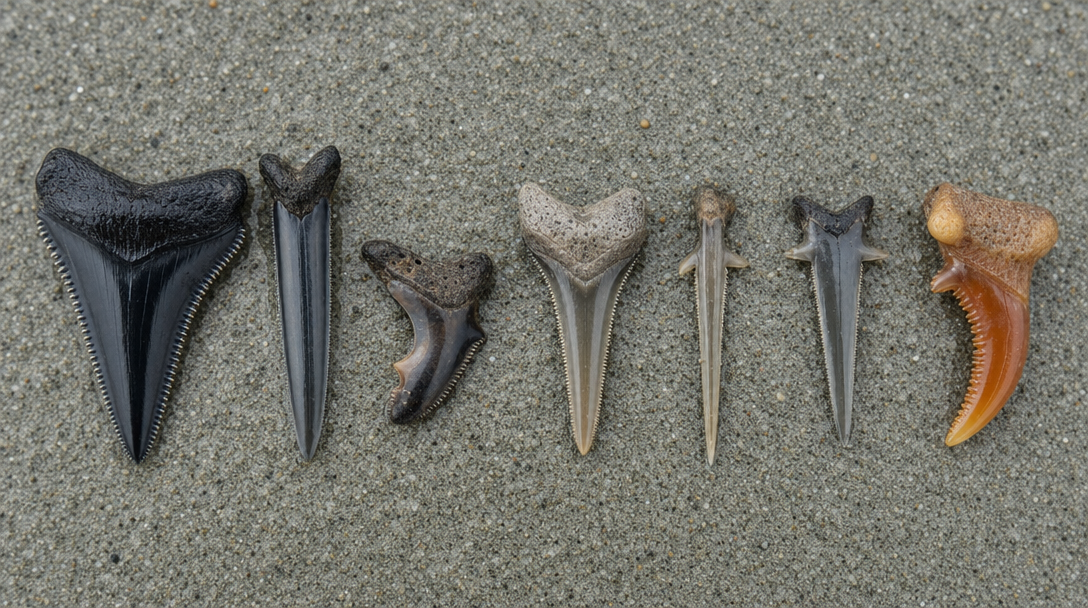
"Do not identify a tooth from one feature. A serrated edge on its own gets you three different sharks. Size, then serrations, then the root — that is what actually narrows it down."— Captain Keith, LowCountry Coastal Excursions
Not a tooth? Here is what else you are picking up
- Ray dental plates — purple-grey, ridged slabs of pavement the animal used to crush oysters and clams. No root, no point. This is the single most common misidentification.
- Fossil bone and vertebrae — porous and light, often barrel-shaped with a dished face at each end
- Drum fish otoliths, the smooth white ear bones locals call lucky stones
- Coral, petrified wood, and phosphate nodules — dark, rounded, and easy to pocket by mistake
Where these teeth actually come from
This is worth getting right, because the version repeated on most Charleston tourism pages is wrong. The fossil-bearing rock under this part of the coast is not one formation and it is not five million years old. The two units that matter most sit beneath the Charleston area and are both Oligocene: the Ashley Formation, dated to roughly 28 to 29 million years, and the Chandler Bridge Formation above it at about 24 to 23 million years.
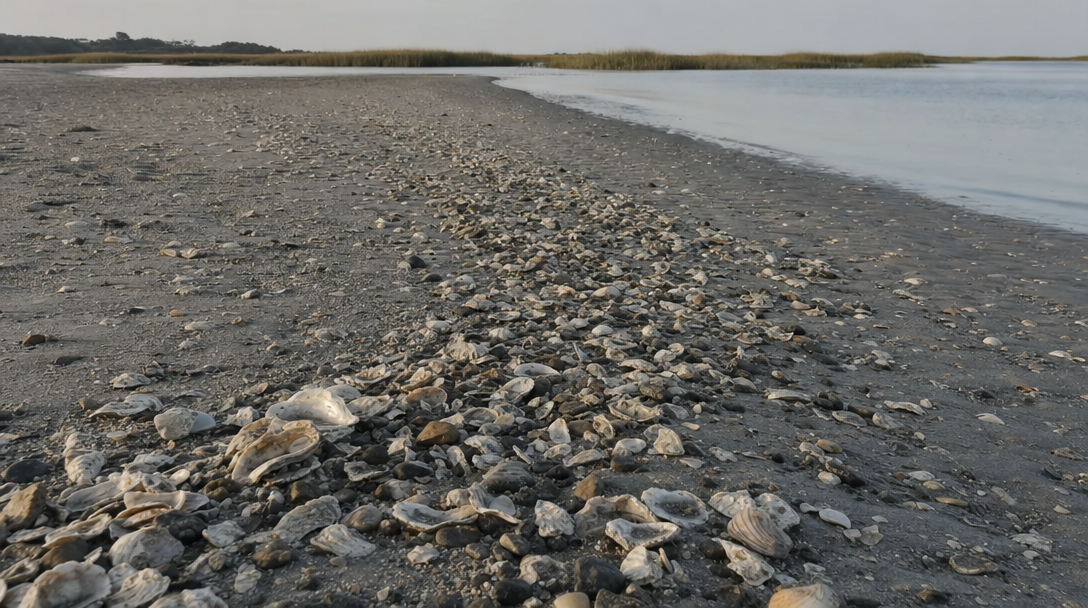
Younger material is mixed in on top: early Miocene sands, Pliocene limestone, and Pleistocene deposits laid down when sea level stood in different places. What ends up on a beach or a sandbar is a shuffled deck drawn from all of them, which is why a 25-million-year-old angustidens and a much younger megalodon can come out of the same handful of shell hash. Nothing sorts them for you. That is also why an isolated tooth cannot be dated by eye — only by what it is.
Why they are black, and what that does not tell you
The dark color is not the original tooth. Over a long burial the enameloid and dentine take up minerals from the surrounding sediment, and the tooth ends up the color of the mud it sat in — black, grey, brown, or in the case of many hemipristis, a warm orange. A tooth from a phosphate-rich bed comes out darker than one from clean sand of the same age. Color therefore tells you about the sediment, not the species and not the age. Bright white teeth are modern, and they almost never survive long enough on this coast to be worth picking up.
Megalodon: how old is old
The species itself is genuinely gone, and the date has moved. A 2019 review that re-examined every late record and threw out the reworked ones concluded megalodon was extinct by about 3.6 million years ago, roughly a million years earlier than the figure most older articles still quote. If you find one on a Lowcountry beach, the animal it came from had been dead for a very long time before there was anyone here to look for it.
What the law says about keeping what you find
This trips people up, and it is worth being precise because the line is physical, not a matter of intent. South Carolina claims the submerged land, and state jurisdiction starts at the mean low water mark. Surface-collecting a tooth lying on the dry beach above that line is ordinary beachcombing. Collecting below it — in a creek, a river, or off the bottom anywhere the state holds title — requires a Hobby License issued by the South Carolina Institute of Archaeology and Anthropology.
- It is inexpensive: five dollars for six months for residents, ten for non-residents, with a cheaper two-year rate.
- It permits hand collection only. No shovels, rakes, scoops, or screens, and no moving sediment to expose anything — even on a dry riverbank in a drought.
- Licensees report fossil finds to the South Carolina State Museum quarterly, and title passes to you after the report is reviewed.
- It is worth knowing that South Carolina is unusual in allowing recreational collecting from submerged sites at all.
Practically speaking: if you are walking a beach and pocketing what the tide left, you are fine. If you are planning to work a riverbed, get the license first.
Still not sure? Bring it to the captain
On our Morris Island trips identifying finds is half the day, and there is no substitute for putting a tooth in someone's hand who has seen a few thousand of them. If you are not on the water with us, photograph the tooth on a plain background with a coin beside it for scale, and get both faces and the edge-on view — the root and the profile are where the answer usually is.
Pricing, BYOB rules, weather policy, and departure details are all on our FAQ page — or call (843) 874-8555.
Frequently Asked
How can you tell a megalodon tooth from other shark teeth?
Size and the root. Megalodon teeth are broad triangles with fine, even serrations along both edges and a thick, heavy root, often with a darker chevron band called the bourlette between crown and root. Anything over three inches is almost certainly a meg. Check the shoulders of the crown for small side cusplets — if they are there, it is Otodus angustidens, not megalodon.
What is the most common shark tooth found in Charleston?
Sand tiger. They are slender, smooth and needle-like with tiny cusps at the base of the crown, usually under three-quarters of an inch, and they make up the majority of finds on a typical Lowcountry hunt.
Why are fossil shark teeth black or grey?
Because minerals from the surrounding sediment replace the original material during a long burial. The tooth ends up the color of the mud it sat in, so color reflects the deposit rather than the species or the age. Bright white teeth are modern and rarely survive on the beach.
What is a snaggletooth?
The common name for Hemipristis, a shark whose hooked teeth carry coarse serrations along the upper edge only and often come out orange or amber. They are among the most sought-after finds on this coast.
I found a flat, ridged purple plate — what is it?
A ray dental plate. Rays used these pavement-like plates to crush oysters and clams. They have no root and no point, they are common in the Lowcountry, and they are the fossil most often mistaken for a tooth.
How old are the shark teeth found near Charleston?
Older than most sources say. The main fossil-bearing units under the Charleston area are Oligocene — the Ashley Formation at roughly 28 to 29 million years and the Chandler Bridge Formation at about 24 to 23 million years — with younger Miocene, Pliocene and Pleistocene material mixed in above them. A single beach find can come from any of them.
Do you need a license to collect shark teeth in South Carolina?
It depends where you are standing. Surface-collecting from the dry beach above the mean low water mark needs no license. Collecting below that line, including in rivers and creeks, requires a Hobby License from the South Carolina Institute of Archaeology and Anthropology. The license allows hand collection only — digging and tools are prohibited anywhere in state waters.
Local captain with LowCountry Coastal Excursions, running tours out of Shem Creek since 2017.