
Whether you may keep a shark tooth in South Carolina turns on one boundary you can usually see at your feet. State law claims fossils from submerged lands up to, but not above, the line of mean low tide. Pick a tooth off the dry beach and you are beachcombing. Recover one from a creek, river or harbour bottom below that line and you need a Hobby License, hand collection only, with quarterly reporting. Federal land is stricter than both. Here is each case, sourced to the statute and the issuing institute.
Is it legal to keep shark teeth in South Carolina? In most of the places visitors actually go, yes, and no permit is involved. The question comes up on nearly every trip, usually about ten minutes after somebody finds their first one and starts wondering whether they are allowed to put it in their pocket. The reason the answer is yes matters, because the same tooth picked up forty feet away can be a different legal situation entirely. South Carolina does not regulate this by object. It regulates it by ground. Work out which side of one line you are standing on and the rest follows.
Key takeaways
- State law draws the line at mean low tide. Above it, surface collecting on the beach is ordinary beachcombing and needs no permit.
- Below that line — creeks, rivers, the harbour bottom — fossils belong to the State, and recovering them needs a Hobby License.
- The licence is cheap and easy: five dollars for six months in state, ten out of state. Cost is not the obstacle; the method rules are.
- Hand collection only. No digging, no moving sediment, no screens or scoops anywhere in state waters, and magnet fishing is prohibited outright.
- Federal land is stricter than state law, not looser. On National Park Service ground, collecting fossils is prohibited with no hobby equivalent.
- Fossil finds under the licence are reported quarterly to the State Museum, and title passes to you within 60 days of that report.
The line that decides it is mean low tide
South Carolina handles this under the Underwater Antiquities Act, and the operative sentence is a definition rather than a rule. The Act defines the State territorial waters it governs as all tidal waters within the boundaries of the State up to, but not above, the line of mean low tide, and seaward three geographical miles from the coastline. Everything the statute says about who owns a fossil applies inside that envelope and stops at its edge.
That is a physical boundary, not a question of intent, and it is the reason two people can be twenty yards apart doing legally different things. It is also why the usual shorthand you hear around here — beaches are fine, rivers need a licence — is roughly right for the wrong reason. The rivers need a licence because their beds sit below mean low tide, not because they are rivers.
Above the line: the dry beach
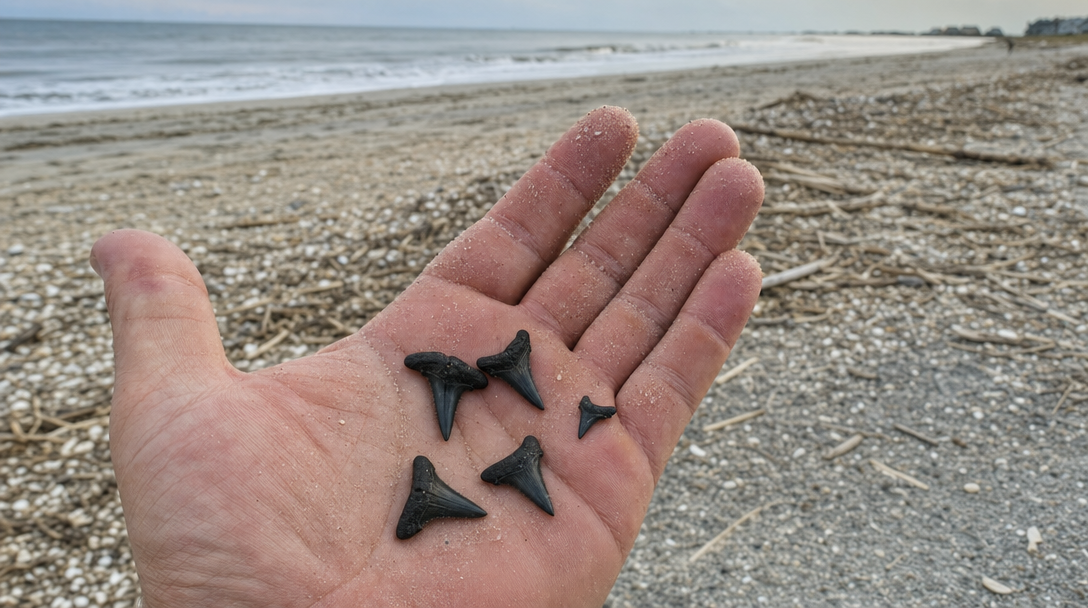
This covers almost everything a visiting family does. Walking a wrack line, turning over shell hash, picking up the shark teeth the last tide left on the exposed sand at Morris Island or anywhere else along the coast — the State has made no claim on that material under this chapter, because it is not on submerged land as the Act defines it. There is no form, no fee and no report. Put it in your pocket.
Two caveats that are not about fossils at all. The beach may be private upland above the high-water line, in which case access is the landowner's call regardless of what you pick up. And some barrier islands sit inside protected areas with their own rules, which is the federal question further down. Neither changes the fossil answer; both can change whether you should be standing there.
Below the line: the Hobby License
Once you are recovering material from a creek bed, a river bottom or anywhere else the State holds title to, you are inside a different regime. The Act declares that all submerged archaeological historic property and artifacts and all submerged paleontological property located on or recovered from submerged lands over which the State has sovereign control are the property of the State. The Hobby License is the mechanism by which an ordinary person is allowed to collect that property and then be given title to it.
It is issued by the Maritime Research Division of the South Carolina Institute of Archaeology and Anthropology at the University of South Carolina, and it is state-wide rather than site-by-site. South Carolina DNR enforces in the field, which is why people often assume DNR issues it. It does not.
| Where you are | Whose rules | Licence needed | What you may do |
|---|---|---|---|
| Dry beach, above mean low tide | Not State territorial waters under the Act | None | Surface collect by hand, keep what you find |
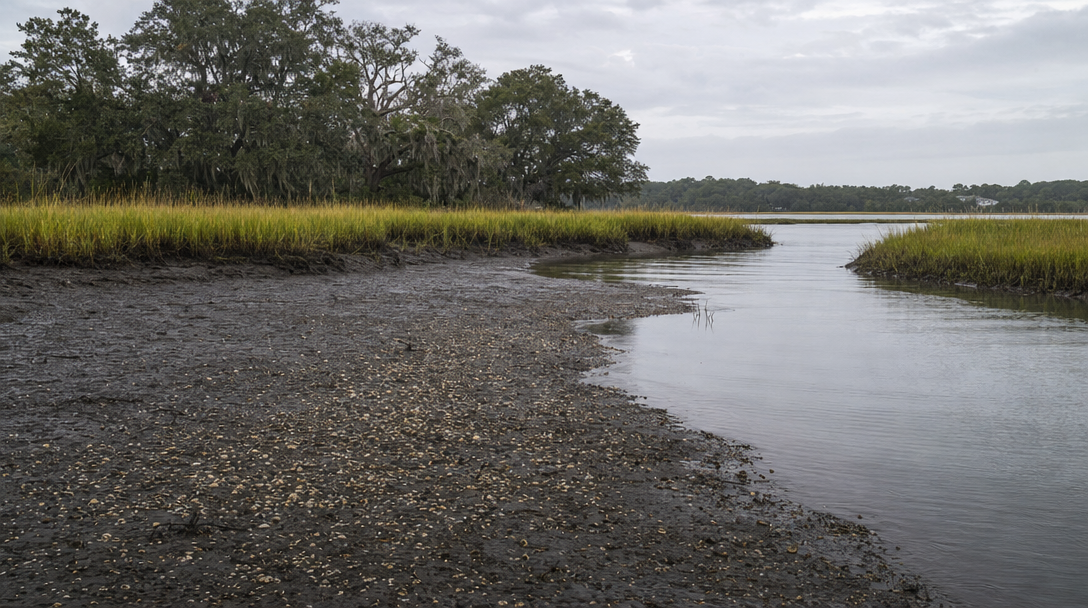
| Creek, river or harbour bottom below mean low tide | State of South Carolina, licensed by the Institute | Hobby License | Hand collection of exposed material only |
| A shipwreck site in State waters | State, same licence, extra limit | Hobby License | No more than ten artifacts a day from that site |
| National Park Service ground, such as Fort Sumter | Federal, National Park Service | No hobby route exists | Look and photograph. Collecting is prohibited |
| Other federal land and refuges | Federal, under the Paleontological Resources Preservation Act | Research permit only | Nothing without an institutional permit |
| Private upland property | The landowner | Permission, not a licence | Whatever the owner agrees to in advance |
What the licence actually costs and demands
The fee is not the point. Five dollars buys six months for a South Carolina resident and ten dollars does the same for a non-resident, with two-year versions at eighteen and thirty-six. Nobody is priced out. What catches people is the method restriction, because it rules out most of how amateurs imagine river collecting works.
- Recovery must be by hand, without mechanical devices and without excavation.
- Licensees are never permitted to dig or move sediment to expose material — that restriction is absolute, not a fair-weather rule.
- Only material already exposed or resting on the bottom sediments may be recovered.
- Magnet fishing is prohibited in South Carolina waterways.
- Fossil finds are reported quarterly to the South Carolina State Museum; artifacts go to the Institute.
- Title to your finds is released to you within 60 days of each report being received.
Read the digging clause twice, because it is where well-meaning people go wrong. A scoop, a garden trowel, a kitchen sieve and a home-made sifting screen are all excluded. The licence permits you to pick up what the river has already uncovered. It does not permit you to go looking underneath.
"All submerged archaeological historic property and artifacts and all submerged paleontological property located on or recovered from submerged lands over which the State has sovereign control, are declared to be the property of the State."— South Carolina Code of Laws, Section 54-7-630(A)
Federal ground runs on a different rulebook
This is the part that surprises people, because the instinct is that federal land will be more relaxed than a state permit scheme. It is the reverse. In National Park System units, possessing, destroying, injuring, defacing, removing, digging or disturbing fossilised and non-fossilised paleontological specimens from their natural state is prohibited, and there is no hobby-licence equivalent. Collection permits exist only for representatives of scientific and educational institutions.
The Paleontological Resources Preservation Act sits behind that across federal land generally, and it carries criminal and civil penalties rather than the modest fine the state hobby rules attract. Charleston has federal ground in the middle of the picture — Fort Sumter is the obvious one — so this is not an abstract concern for someone working the harbour. If you are unsure whose ground you are on, that uncertainty is itself the answer: do not collect there.
Penalties, selling, and taking teeth home
The penalty for breaching the hobby-licence provisions is a misdemeanour carrying a fine of not more than fifty dollars. That number is genuinely small, and it is worth being straight about it rather than implying otherwise — but it is also the wrong thing to optimise around. Commercial-scale violations sit under a separate provision with a ceiling of ten thousand dollars or up to a year, and the federal exposure above is in a different class again.
On selling: title to licensed finds passes to you after the quarterly report is reviewed, but the licence itself covers recreational, non-commercial search and recovery. If you are contemplating selling material recovered under it, ask the Institute directly rather than reasoning from the licence text. A tooth picked up off the dry beach above the tide line never entered that system at all, so it is yours in the ordinary way. Nothing in state law stops you carrying it out of state.
What this means for an ordinary day out
For the overwhelming majority of people asking the question, the answer is: yes, keep it, no paperwork. Beach collecting above the tide line is exactly what it looks like. The licence question only becomes live when someone moves to river diving, which is a genuinely different activity with different gear, different risk and a real permit behind it — and it is where the heavy museum-shaped megalodon material tends to come from, which is why the two subjects get tangled together in the first place.
Our own trips stay firmly on the simple side of the line. We put people on exposed banks and beaches on a falling tide and let the water do the excavating, which is both the legal position and, as it happens, the productive one. Nobody on a family fossil hunt with us needs a licence, because nobody is recovering anything from a State bottom. If you want the fuller picture of the ground itself, our guide to shark tooth hunting on Morris Island covers where the material comes from and how to read a bank.
The trip runs out of Shem Creek on the Roamer IV, which carries up to 23. What we can do on the water that a statute cannot is tell you what is in your hand, and whether the thing you just picked up is worth the walk back to show somebody.
One last note, and it is the honest one. This page is a plain-language summary of published rules, not legal advice, and the rules can be amended. The two sources worth going to directly are the Act itself and the Institute that issues the licence — both are linked above, both are readable, and between them they answer almost every version of this question.
Pricing, BYOB rules, weather policy, and departure details are all on our FAQ page — or call (843) 874-8555.
Frequently Asked
Is it legal to keep shark teeth found in South Carolina?
In most cases, yes. If you picked it up off the dry beach above the mean low tide line, the State has made no claim on it under the Underwater Antiquities Act and there is no permit, fee or report involved. It becomes a different question only when the tooth is recovered from below that line — a creek, river or harbour bottom — where fossils are State property and a Hobby License is required, or when you are on federal land, where collecting is prohibited outright.
Do I need a licence to look for shark teeth on the beach?
No. Surface collecting on the dry beach is ordinary beachcombing. The statute defines the waters it governs as reaching up to, but not above, the line of mean low tide, so the exposed beach sits outside it. What can still apply is property access — some beachfront above the high-water line is private upland — and any separate rules attached to a protected area you may be standing in.
When exactly do I need a South Carolina Hobby License?
When you are recovering artifacts or fossils from submerged lands the State holds title to, which in practice means anything below the mean low tide line: creek beds, river bottoms and the harbour floor. It is issued state-wide by the Maritime Research Division of the South Carolina Institute of Archaeology and Anthropology, and it costs five dollars for six months in state or ten out of state, with two-year options at eighteen and thirty-six dollars.
Can I use a shovel, scoop or sifting screen?
Not in state waters. Recovery under the Hobby License must be by hand, without mechanical devices and without excavation, and licensees are never permitted to dig or move sediment to expose material. Only what is already exposed or resting on the bottom may be recovered. Magnet fishing is prohibited in South Carolina waterways as well. This method restriction, rather than the fee, is what most people get wrong about the licence.
Can I collect fossils at Fort Sumter or on other federal land?
No. In National Park System units, possessing, removing, digging or disturbing fossilised and non-fossilised paleontological specimens is prohibited, and there is no hobby-licence route for visitors — collection permits are limited to representatives of scientific and educational institutions. The Paleontological Resources Preservation Act backs that across federal land generally and carries criminal and civil penalties. If you are not certain whose ground you are on, do not collect.
What is the penalty for collecting without a licence?
Breaching the hobby-licence provisions is a misdemeanour with a fine of not more than fifty dollars. Violating the terms of an exclusive commercial licence is a separate and much heavier offence, punishable by a fine of up to ten thousand dollars or up to a year, or both. Federal penalties under the Paleontological Resources Preservation Act are in a different class again and include both criminal and civil exposure.
Can I sell shark teeth I found in South Carolina?
A tooth picked up from the dry beach above the tide line never entered the state licensing system, so it is yours in the ordinary way. Material recovered under a Hobby License is different: title passes to you within 60 days of the quarterly report being received, but the licence covers recreational, non-commercial search and recovery. If you plan to sell material collected under it, ask the Institute directly rather than inferring an answer from the licence text.
Do I have to report what I find?
Only for material recovered under the Hobby License from state waters. Those finds are reported quarterly — fossils to the South Carolina State Museum and artifacts to the Institute — and the Institute releases title to the licensee within 60 days of receiving each report. Nothing collected from the dry beach above the mean low tide line has any reporting requirement attached to it.
Local captain with LowCountry Coastal Excursions, running tours out of Shem Creek since 2017.