
Morris Island is the best place near Charleston to hunt shark teeth — a boat-access-only barrier island just south of the harbor where megalodon, mako, tiger, and sand tiger teeth wash up with every tide. Go within two hours of low tide, surface-collect only (it's legal — no license needed on the beach), and you'll do best on a guided trip out of Shem Creek that times the tide for you.
Morris Island is the single best place to hunt shark teeth near Charleston — and the catch is that you can't drive there. It's an undeveloped barrier island just south of Charleston Harbor with no bridge and no road, so the beaches don't get picked over the way Folly does. Every tide pulls fresh fossils out of the harbor channel and lays them along the north end near the old lighthouse. This is the full guide to hunting it: the teeth, the tide, the gear, the law, and how to get out there.
Why Morris Island Beats the Public Beaches
The thing that makes Morris Island produce is the same thing that keeps it quiet — no road access. A strong tidal current runs past the north end and drops shells, bone, and teeth in the same wrack lines day after day. On Folly Beach you're combing behind a hundred other people; on Morris Island you're often the first set of footprints since the last high tide.
- No bridge or parking lot, so the beach stays far less picked-over
- A strong harbor current delivers fresh teeth on every tide
- Megalodon, mako, tiger, and sand tiger teeth all turn up here
- Sand dollars, whelks, and dolphins on the ride out from Shem Creek
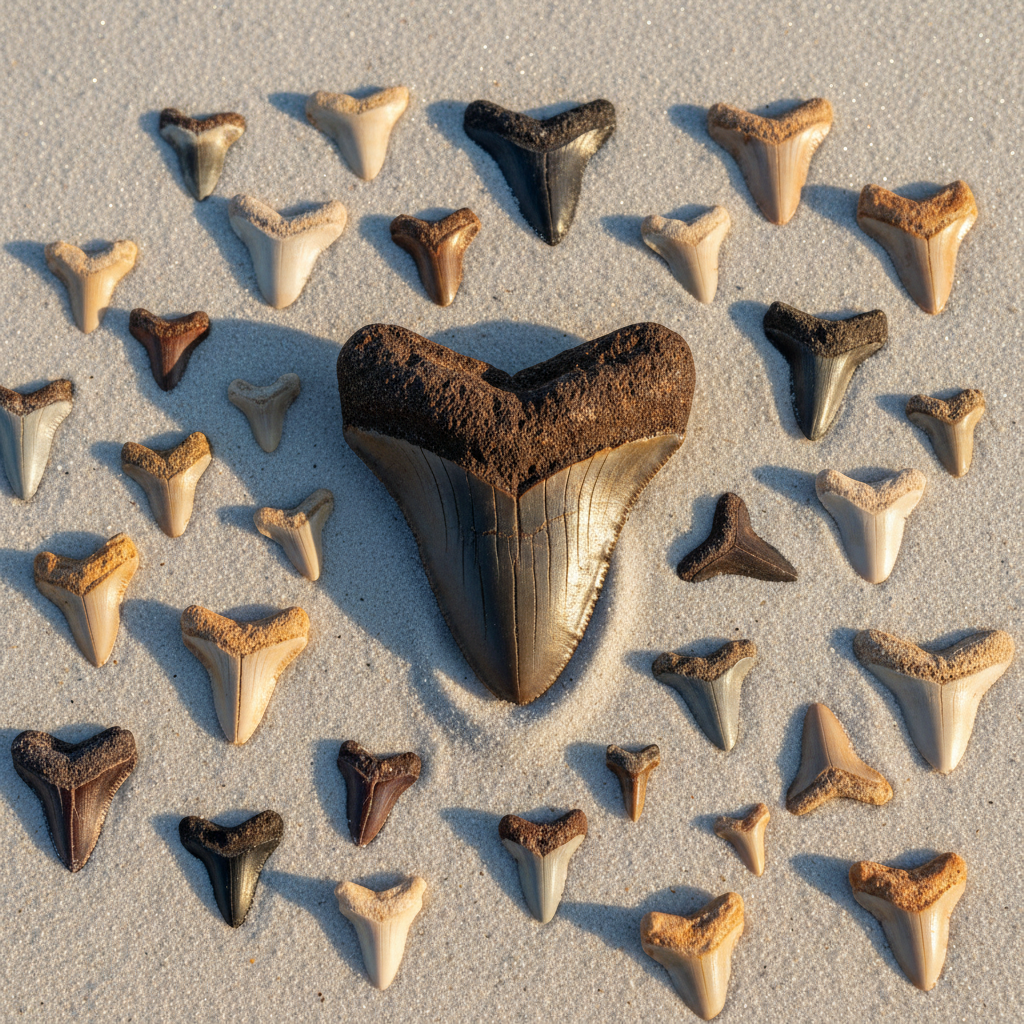
Which Shark Teeth You'll Actually Find
Almost every tooth on Morris Island comes from one of five sharks. Learning them turns a handful of dark gravel into a story.
- Megalodon — the prize: thick and triangular, usually small or worn on the beach (big complete ones come out of the rivers)
- Mako — smooth, narrow, and dagger-like, with no serrations
- Tiger — curved with a deeply serrated, almost comb-like edge
- Sand tiger — slender and smooth with little side cusps
- Hemipristis ('snaggletooth') — colorful and hook-shaped, a collector favorite
You'll also turn up ray dental plates and bits of fossil bone that get mistaken for teeth. Look for glossy, triangular shapes that stand out against the dull beige shell hash — that's almost always a tooth.
The Best Time and Tide to Go
Timing matters more than luck. The best window is the two hours around low tide, when the gravel and shell-hash beds where teeth settle are exposed. A falling tide a day or two after a storm or a hard blow is ideal — rough water churns fresh material up from offshore. It's a year-round hunt, but winter and early spring can be the best of all: fewer people and bigger swells moving the sand.
- Hunt within about two hours of low tide
- A day or two after a storm or front is prime
- Early morning beats the crowds to fresh teeth
- Year-round — winter and early spring are quietly the best
What to Bring
- A mesh bag or jar for your finds
- Closed-toe water shoes — oyster shells are sharp
- Sunscreen, water, and a hat; there's no shade out there
- Polarized sunglasses to cut glare on the wet sand
- Optional: a small scoop or strainer for sifting shell beds
Is It Legal to Keep What You Find?
Yes. Surface-collecting fossilized shark teeth from South Carolina beaches for personal use is legal — what you pick up off the sand is yours. The one rule that trips people up is that it's beachcombing only: digging into the riverbed or bank isn't allowed, and collecting fossils from state river bottoms requires a South Carolina Hobby Diver License. On a Morris Island beach hunt you're only surface-combing, so there's nothing to worry about and no permit to pull.
How to Get There: Guided Trips from Shem Creek
There's no public ferry, so unless you've got your own boat and know the tides, a guided trip is how you get on Morris Island. Ours leave from Shem Creek in Mount Pleasant — about 14 minutes from downtown Charleston — and the captain times the run to drop you on the most productive stretch at the right tide, then stays with the group to help everyone find their first tooth.
- Morris Island Shark Tooth & Fossil — shared seats, 4 hours, $125 per person (up to 6 guests)
- Shark Tooth & Sea Shell Hunting — private whole-boat charter, 3 hours from $400 or 4 hours from $500 (covers 1–2, then +$50 per guest up to 12), optional private guide +$150
- Harbor Island Hopping & Shark Tooth — private, 2 hours from $375 (1–4 guests), up to 23 aboard the Roamer IV
All prices are the base rate (a 3% card surcharge applies at checkout), and you keep every tooth you find. If you're weighing the options, our review of the best fossil hunting boat tours in Charleston lays them side by side, and the family guide to finding megalodon teeth in South Carolina covers the kid-friendly spots.
Pricing, BYOB rules, weather policy, and departure details are all on our FAQ page — or call (843) 874-8555.
Frequently Asked
Can you drive to Morris Island?
No. Morris Island has no bridge or road — it's reachable only by boat. Most visitors go on a guided shark tooth hunting tour out of Shem Creek in Mount Pleasant, which handles the navigation and the tide.
What shark teeth are found on Morris Island?
Mainly five species: megalodon, mako, tiger, sand tiger, and hemipristis ('snaggletooth'). You'll also find shells, sand dollars, and bits of fossil bone.
Do you need a permit to hunt shark teeth on Morris Island?
No. Surface-collecting fossilized teeth off the beach for personal use is legal in South Carolina with no license. A South Carolina Hobby Diver License is required only to collect fossils from state river bottoms.
When is the best time to hunt shark teeth on Morris Island?
Within about two hours of low tide, ideally a day or two after a storm. It's a year-round hunt, and winter and early spring are often the most productive — fewer crowds and bigger swells.
How much is a Morris Island shark tooth tour?
The shared 4-hour Morris Island trip is $125 per person; private Shark Tooth & Sea Shell charters start at $400 for 3 hours. A 3% card surcharge applies at checkout.
Is Morris Island good for kids?
It's one of the most family-friendly outings in Charleston. The teeth are easy to spot once you know what to look for, life jackets are provided, and the captain helps everyone find their first one.
Local captain with LowCountry Coastal Excursions, running tours out of Shem Creek since 2017.