
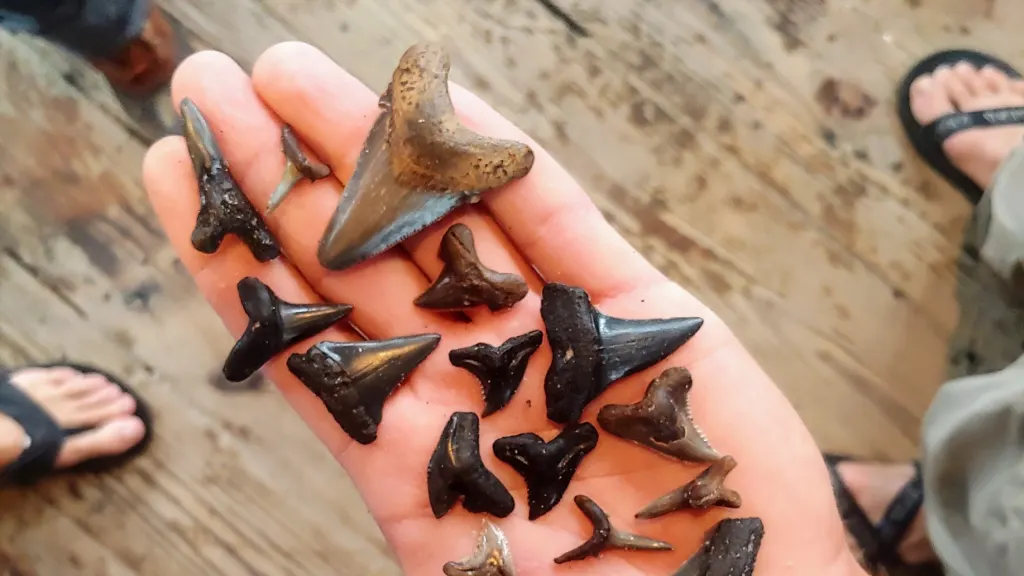
You can find megalodon teeth all over coastal South Carolina — the most family-friendly spots are Morris Island, the Stono River sandbars, and Folly Beach, where fossilized teeth wash into the shell beds on every low tide. Big complete megalodon teeth mostly come from the rivers (divers need a South Carolina Hobby Diver License), but kids regularly find smaller ones right on the sand. Go around low tide, surface-collect only, and bring a guide for the boat-access spots.
Few things light up a kid like pulling a real megalodon tooth out of the sand — a tooth from a shark longer than the boat they're standing on. South Carolina's coast is one of the best places in the country to do it, and most of the good spots are easy enough for a family afternoon. Here's where to go, when, and how to keep it safe and fun.
Where to Find Megalodon Teeth in South Carolina
The teeth wash out of the fossil beds under the Lowcountry's rivers and seabed — the Oligocene Ashley and Chandler Bridge Formations, roughly 28 to 23 million years old, with younger material reworked above them. Every tide loosens them and scatters them along the beaches and sandbars. A few spots stand out for families:
- Morris Island — boat-access-only, so the wash zones and shell beds on the harbor side stay loaded with teeth
- Stono River sandbars — shallow, calm, and kid-friendly, with a steady supply of smaller teeth
- Folly Beach — drive right up and comb the wrack lines, especially after a storm
- Cooper River — famous for big megalodon teeth, but those come from diving the bottom, which requires a South Carolina Hobby Diver License
When to Go: Tides and Weather
Work the tide chart. The two hours before and after low tide expose the most ground, and a falling tide a day or two after a storm churns up fresh teeth from offshore. Early morning and late afternoon are easiest on kids — cooler, calmer, and less crowded. It's a year-round activity in South Carolina, not a summer-only one.
Shark Tooth Hunting Tips for Families
- Teach kids to look for glossy black, gray, or tan triangles against the dull beige shell hash
- Focus on the gravel and shell beds, not the open sand
- Pick the less-accessible spots — they're far less picked-over
- A small sifter or kitchen strainer turns the hunt into a game
What to Pack
- Polarized sunglasses to cut glare on the water
- Water shoes — shells and oysters are sharp
- Zip-top bags for everyone's finds
- Sunscreen, hats, water, and snacks; there's little shade on the sandbars
- A change of clothes — kids will get wet
Is It Safe and Legal for Kids?
Both. Surface-collecting fossilized teeth off the beach is legal in South Carolina and needs no license — you only need the Hobby Diver License to collect from river bottoms. For safety, the boat-access spots are best done with a guide: on our trips, life jackets are provided for kids and the captain stays with the group on the beach the whole time. Tours run in light rain; if the weather really turns, we reschedule. Full pricing and the weather policy live on our FAQ page.
Guided Trips for Families
If you want to reach the best beaches without your own boat, a guided trip is the easy button. Shared shark tooth hunting seats start at $75 per person on the seasonal Crab Bank hop, and the 4-hour Morris Island trip runs $125 per person. Prefer the whole boat to yourselves? Private Shark Tooth & Sea Shell charters start at $400 for a 3-hour trip (base covers 1–2 guests, then $50 per extra guest), with an optional private fossil guide for $150. Every trip leaves from Shem Creek in Mount Pleasant, and you keep what you find.
However you do it, finding a megalodon tooth is the kind of Charleston day a kid talks about for years. For the Charleston-specific spots and the biggest river finds, see our guide on where to find megalodon teeth near Charleston.
Pricing, BYOB rules, weather policy, and departure details are all on our FAQ page — or call (843) 874-8555.
Frequently Asked
Where can kids find megalodon teeth in South Carolina?
The most family-friendly spots are Morris Island, the Stono River sandbars, and Folly Beach. Kids regularly find smaller teeth right on the sand; the big complete ones usually come from the rivers.
Do you need a license to collect megalodon teeth in SC?
No license is needed to surface-collect fossilized teeth off the beach. A South Carolina Hobby Diver License is required only to collect fossils from state river bottoms like the Cooper River.
Are megalodon teeth easy to find on the beach?
Small ones, yes — especially around low tide and after a storm. Large complete megalodon teeth are rarer and are usually recovered by divers in the rivers.
What age is good for shark tooth hunting?
Any age. It's one of the most kid-friendly outings in Charleston — the teeth are easy to spot once you know what to look for, and the captain helps the little ones.
How much is a family shark tooth tour?
Shared seats start at $75 per person (seasonal Crab Bank) and $125 per person for the 4-hour Morris Island trip; private charters start at $400. A 3% card surcharge applies at checkout.
Local captain with LowCountry Coastal Excursions, running tours out of Shem Creek since 2017.