
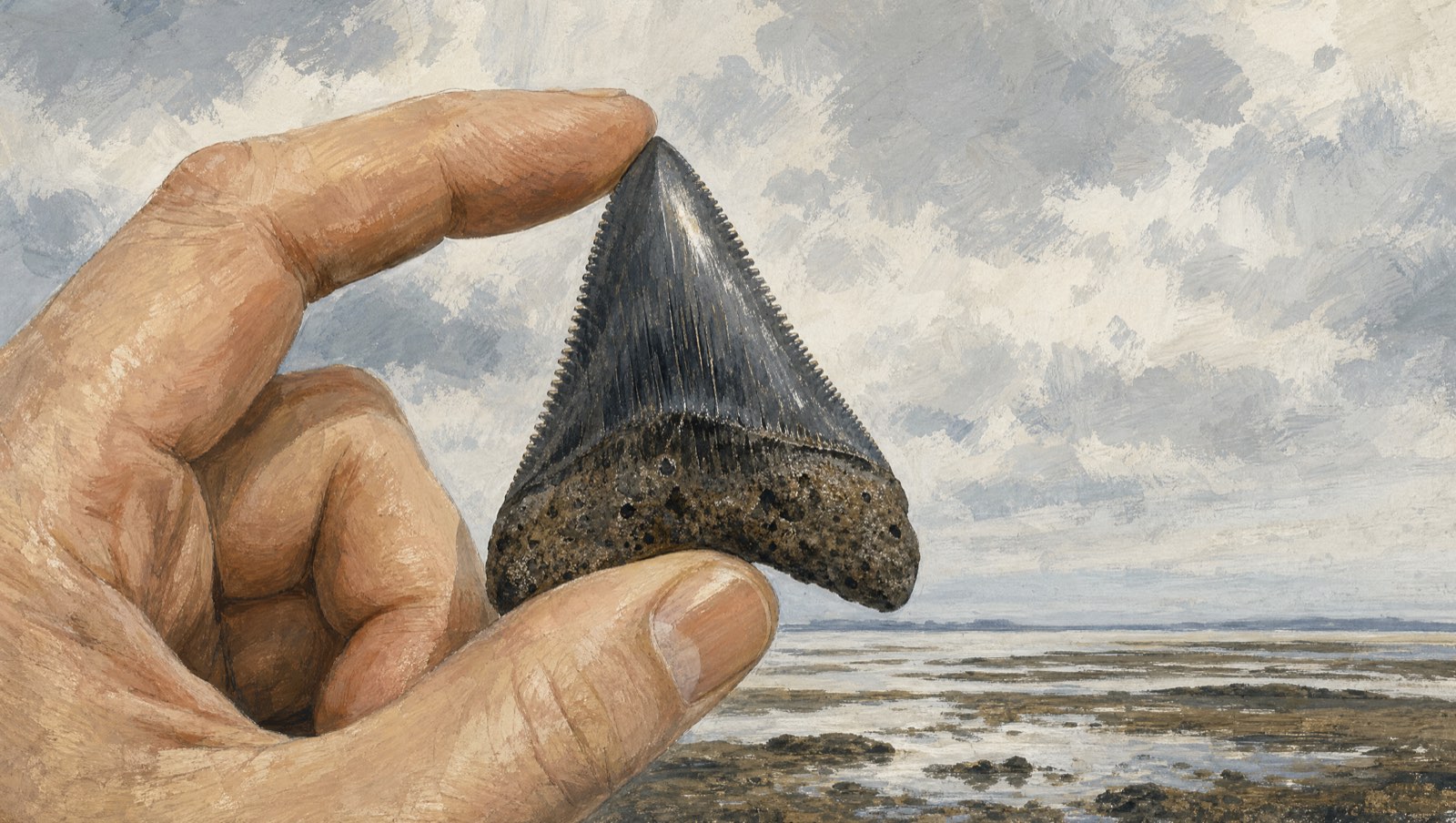
A great white shark tooth is a broad, flat triangle with coarse serrations running down both cutting edges, set on a thick root, with no dull band between the enamel and the root. Smooth edges rule out a great white; serrations plus that band point to megalodon.
A great white shark tooth is a broad, flat triangle with coarse serrations running down both cutting edges, set on a thick root, with no dull band between the glossy enamel and the root. Those three features, checked in that order, separate it from the two teeth it gets confused with on a beach: the smooth-edged broad-toothed mako and a small megalodon. LowCountry Coastal Excursions runs tide-timed trips out of Mount Pleasant, and a tooth somebody hopes is a great white is one of the questions we sort on the sand.
Key takeaways
- Serrations come first. A broad triangular tooth with a smooth edge is not a great white, however big it is.
- Look just above the root. Megalodon teeth carry a band of exposed dentine there, called a bourlette. Great white teeth do not.
- Size does not settle it. A juvenile megalodon tooth overlaps the size range of a broad-toothed mako tooth, and a small white shark's teeth run well under an inch.
- Great whites are a young species by fossil standards. They likely descend from the broad-toothed mako, not megalodon.
- A loose beach find cannot tell you which bed it washed out of, so an exact age for one is a guess.
Feature one: the serrated edge
Run a fingernail slowly down one cutting edge from the tip to the root. On a great white you will feel a row of small, even bumps the whole way down, on both edges. That is the check that does most of the work, because the tooth it is easily confused with, the broad-toothed mako, has a clean, smooth edge.
The Florida Museum of Natural History ties the difference to diet: modern white sharks have serrations on their teeth for consuming marine mammals, while mako sharks do not have serrations because they primarily feed on fish. The museum's own fossil tooth key sorts Carcharodon, the great white genus, as teeth over 1 inch (2.54 cm) tall with coarse serrations and a thick root.
Worn teeth complicate this. A tooth that has rolled in the surf for a long time can lose the fine detail along its edges, and a heavily worn serrated tooth and a smooth one start to look alike. When the edge is ambiguous, check the full length of both edges, including the stretch just above the root, and look at the tooth under a low, raking light rather than straight on.
Feature two: a broad, flat triangle
Lay the tooth flat on your palm. A great white tooth is large and triangular, wide at the base and tapering to a point, with a fairly flat front face. That broad, flat shape is exactly what it shares with the broad-toothed mako, which is why shape alone never settles an identification here.
Compare it with the living shortfin mako instead and the difference is obvious. The Florida Museum describes fossil shortfin mako teeth as smooth-edged like the broad-toothed mako but with much narrower, more curved crowns and longer root lobes. If what you are holding is slender and hooked like a dagger, you are well away from great white territory and closer to the teeth covered in our guide to identifying shark teeth by species.
Feature three: nothing between the enamel and the root
Turn the tooth over and look at the strip where the shiny blade stops and the root begins. On a megalodon tooth there is a band of exposed dentine there, a duller, often darker chevron called the bourlette. The Florida Museum notes that the broad-toothed mako lacks such a feature, as is true of most other sharks. The ReefQuest Centre for Shark Research is explicit about the great white: such a bourlette does not occur in the teeth of Carcharodon carcharias. It adds that megalodon serrations are much smaller and more regular.
This check matters most on small teeth. A young megalodon tooth is serrated, so it passes feature one, and it can be the right size for a great white. The bourlette is often what separates them, and it is easy to miss on a tooth that is wet and covered in sand, so rinse it and dry it on your shirt before you decide.
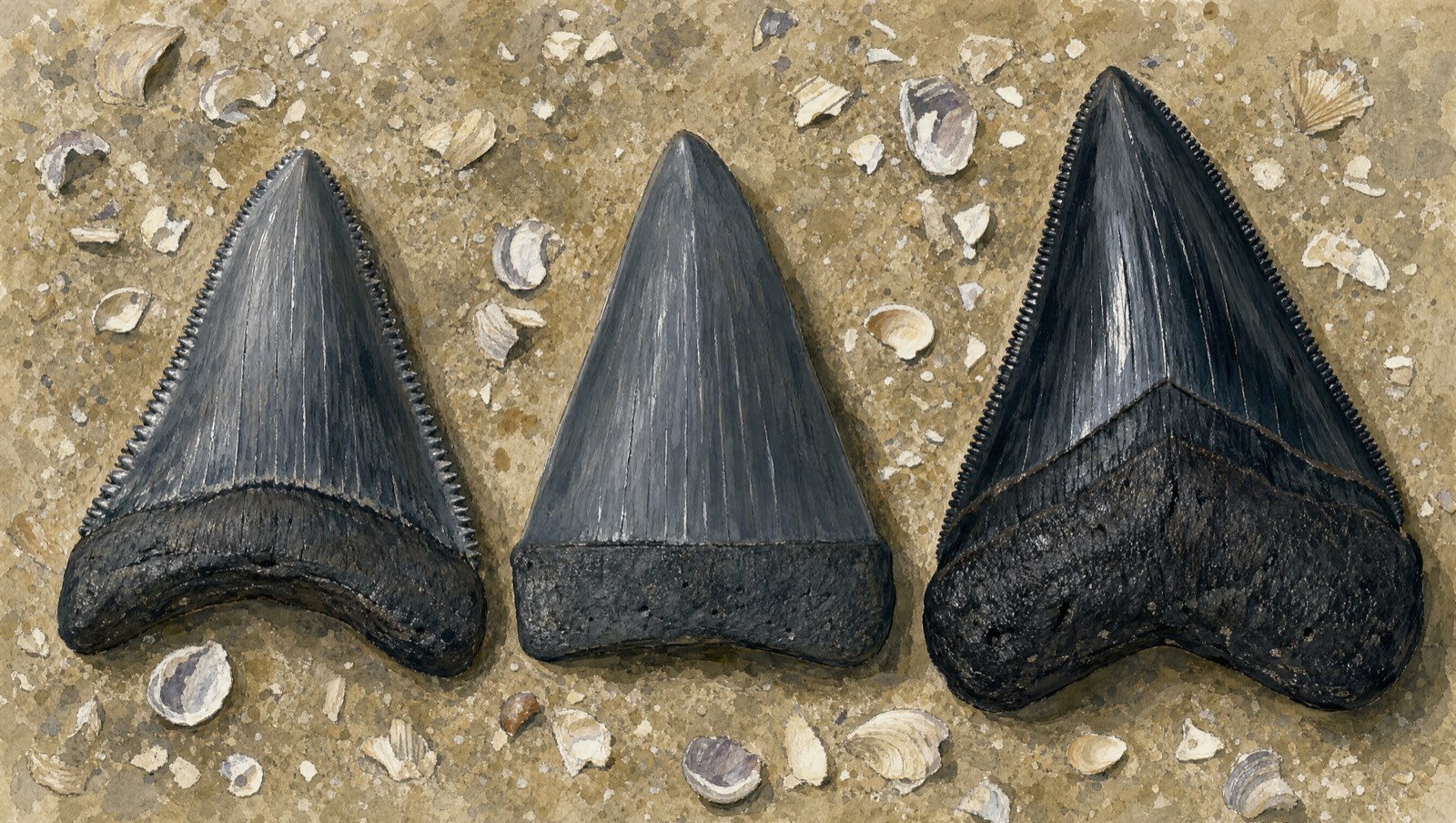
Great white vs mako vs juvenile megalodon
The table puts the three side by side. Every size figure comes from the source named in the row, and none of them are ours.
| Feature | Great white (Carcharodon carcharias) | Broad-toothed mako (Carcharodon hastalis) | Juvenile megalodon (Otodus megalodon) |
|---|---|---|---|
| Cutting edges | Coarse serrations (Florida Museum) | Smooth, unserrated (Florida Museum) | Serrated, with smaller, more regular serrations (ReefQuest) |
| Band of exposed dentine above the root (bourlette) | Absent (ReefQuest) | Absent (Florida Museum) | Present (Florida Museum) |
| Tooth height | First upper front tooth crown: 14.5 mm on a 1.65 m shark, 48.8 mm on a 5.94 m shark (Shimada 2002) | Typically 25 to 75 mm (1 to 3 in) tall in Florida deposits (Florida Museum) | Juvenile teeth overlap the broad-toothed mako size range (Florida Museum) |
| Crown shape | Large and triangular (Shimada 2002) | Upper teeth broadly triangular (Florida Museum) | Not used here; rely on serrations and the bourlette |
| Geologic timing | Newly evolved during the Pliocene (Boessenecker et al. 2019) | Miocene and Pliocene deposits in Florida (Florida Museum) | Extinct about 3.6 million years ago (Boessenecker et al. 2019) |
The height row is the one people misread. In a 2002 paper in the Journal of Fossil Research, Kenshu Shimada measured crown height against body length in the jaws of white sharks of known size, and the relationship is steady: the bigger the shark, the taller the tooth. One of his smaller samples, a male 165 cm long, had a first upper front tooth with a crown 14.5 mm tall. A 594 cm female carried one of 48.8 mm. So a small serrated triangle is not ruled out as a great white just because it is well under an inch.
Where the great white came from, and why it matters for ID
For a long time the great white was filed as a small cousin of megalodon, largely because both have big serrated triangular teeth. The evidence has moved the other way. In 2012 University of Florida researchers named Carcharodon hubbelli from a fossil jaw found in the Pisco Formation of southern Peru, with 222 teeth still in place, and dated it to about 6.5 million years ago. Its coarse serrations are indicative of a transition from broad-toothed mako sharks to modern white sharks.
"We can look at white sharks today a little bit differently ecologically if we know that they come from a mako shark ancestor."— Dana Ehret, lead author, quoted by the Florida Museum of Natural History, 2012
That lineage is the practical point for anyone sorting teeth. The great white and the broad-toothed mako share a shape because one likely descends from the other, so the serrated edge is the character that separates them, and it is the one to check first. Megalodon belongs to a different family, and its bourlette is a separate feature that neither of the other two shares.
How old a fossil great white tooth can be
Younger than most of what turns up around here. A 2019 study in PeerJ by Robert Boessenecker and colleagues put the youngest reliable megalodon records in the early Pliocene and the extinction at about 3.6 million years ago, and suggested that competition with the newly evolved great white shark during the Pliocene may have contributed. A fossil great white tooth therefore dates from the Pliocene or later.
Compare that with the ground under the Charleston area. Two well-documented fossil beds here, the Ashley and Chandler Bridge formations, are Oligocene, more than 15 million years older than the earliest great white. A tooth from those beds cannot be a great white, because the species did not exist yet. Any fossil great white found locally has to have come from younger sediment, and a tooth picked up loose on a beach has been moved by water and carries no label saying which layer it left.
One local footnote on scale: the largest megalodon tooth that Victor Perez, Ronny Leder and Teddy Badaut could physically measure for their 2021 study in Palaeontologia Electronica was found by a diver in the Morgan River in South Carolina, with a crown 122 mm tall and 133 mm wide. Set that beside the 48.8 mm great white crown above and the gap between the largest of each is not subtle. The hard cases are the small ones.
What we see on the beach
Our own species guide does not list the great white among the handful of sharks behind the regular finds here, so treat a great white candidate with healthy suspicion and run all three checks before you celebrate. The plausible mix-ups are a worn serrated tooth from another species, a broad smooth-edged mako, or a small megalodon, and the three checks below are built to catch each one.
On the Morris Island trips, the captain identifies every find on the spot, which is the fastest way to learn these features, because you see the serrations and the bourlette on real teeth in your own hand rather than in a photo. If you would rather run the checks yourself first, our walkthrough of whether a shark tooth is real covers the blade-and-root test that comes before any species question.
Timing matters more than luck. We time every departure around low tide, when the layer that holds the shark teeth is most exposed, and the tour page names October through January as the best season, when Crab Bank is accessible and tides run lowest. We still find teeth year-round.
| Detail | Figure |
|---|---|
| Duration | 3 to 4 hours |
| Price, shared boat | From $125 USD per person |
| Group size aboard | Up to 23 guests |
| Departure point | Shem Creek, Mount Pleasant, South Carolina |
| Departures | Mornings, timed to the tide |
| What you keep | Every tooth you find |
A three-step check you can run in the field
- Edge: drag a fingernail down both cutting edges from tip to root. Smooth all the way means not a great white.
- Band: look at the strip between the glossy blade and the root. A dull chevron of exposed dentine means megalodon.
- Shape: a broad triangle fits a great white. Slender and hooked points to a shortfin mako.
If a tooth passes all three, it is a good great white candidate. If it is unusual, large or scientifically interesting, note where and when you picked it up before anything else, and have it looked at by someone who handles fossil teeth daily. An identification is only as good as the record of where the tooth came from.
Pricing, BYOB rules, weather policy, and departure details are all on our FAQ page — or call (843) 874-8555.
Frequently Asked
How do you identify a great white shark tooth?
Check three things in order. The cutting edges should carry coarse serrations. The crown should be a broad triangle. And there should be no dull band of exposed dentine between the glossy enamel and the root, which is the bourlette that marks a megalodon tooth.
What is the difference between a great white and a mako tooth?
Serrations. A great white tooth has coarse serrations on its cutting edges, while mako teeth are smooth. The broad-toothed mako, Carcharodon hastalis, has a broad triangular upper tooth very like a great white's, so the edge is the deciding feature. The living shortfin mako has much narrower, more curved crowns and longer root lobes.
How can you tell a great white tooth from a small megalodon tooth?
Look just above the root. Megalodon teeth have a band of exposed dentine there, called a bourlette, and great white teeth do not. Both are serrated, and a juvenile megalodon tooth can be the right size for a great white, so the bourlette is often the feature that separates them.
How big is a great white shark tooth?
It depends on the size of the shark. Kenshu Shimada's measurements of white shark jaws found a first upper front tooth crown 14.5 mm tall on a shark 165 cm long and 48.8 mm tall on a 594 cm female. A small serrated tooth can still be a great white.
How old is a fossil great white shark tooth?
Pliocene or younger. A 2019 PeerJ study by Boessenecker and colleagues described the great white as newly evolved during the Pliocene and put megalodon's extinction at about 3.6 million years ago. A loose beach find cannot tell you which bed it came from, so any exact age for one is a guess.
Did great white sharks evolve from megalodon?
The evidence points elsewhere. University of Florida researchers described Carcharodon hubbelli, a fossil white shark from Peru dated to about 6.5 million years ago, whose coarse serrations indicate a transition from broad-toothed mako sharks to modern white sharks. Megalodon sits in a separate family.
Are great white shark teeth found near Charleston?
They are not on the short list of sharks behind the regular finds here, so treat a candidate with suspicion and run the checks. Well-documented fossil beds under the Charleston area, the Ashley and Chandler Bridge formations, are Oligocene, older than the great white itself, so a genuine fossil great white tooth would have come from younger sediment.
Local captain with LowCountry Coastal Excursions, running tours out of Shem Creek since 2017.