
There is no fixed price for a megalodon tooth, and any figure quoted from a photograph is a guess. Value is set by a stack of condition variables read together: whether the tooth is really megalodon rather than its cusped Oligocene relative, how much of the tip and the serrations survive, how complete the root is, the colour, the size, and whether the find has a lawful, stated origin. A small perfect tooth regularly beats a large damaged one. Below: how each variable moves the number, what the published research on the fossil market actually found, and what a Charleston beach find realistically is.
People send us a photograph of a megalodon tooth and ask what it is worth. The honest answer is that a photograph is the wrong instrument for the job. Value here is not a lookup table — it is a stack of condition variables that only mean anything read together, and two teeth of identical size can sit at opposite ends of the range. What follows is how each of those variables works, what the published research on the fossil market actually found, and why there is no price list on this page.
Key takeaways
- No honest figure can be quoted from a photograph. Species, completeness and provenance decide the value, and they need the tooth in hand.
- Check the species first. A broad triangle with pointed cusplets on the shoulders of the crown is Otodus angustidens, not a small meg.
- Completeness beats size. An original tip, unworn serrations and a whole root matter more than another half inch of crown.
- An isolated tooth is weak evidence of how big the animal was, so treat size claims in sales copy with suspicion.
- The market is not a one-way bet — the one long-run study of fossil selling prices found supply rising and a four-fossil basket losing value.
- Provenance is part of the value. Below the mean low water mark in South Carolina, collecting needs a Hobby License and hand collection only.
Start by checking it is a megalodon at all
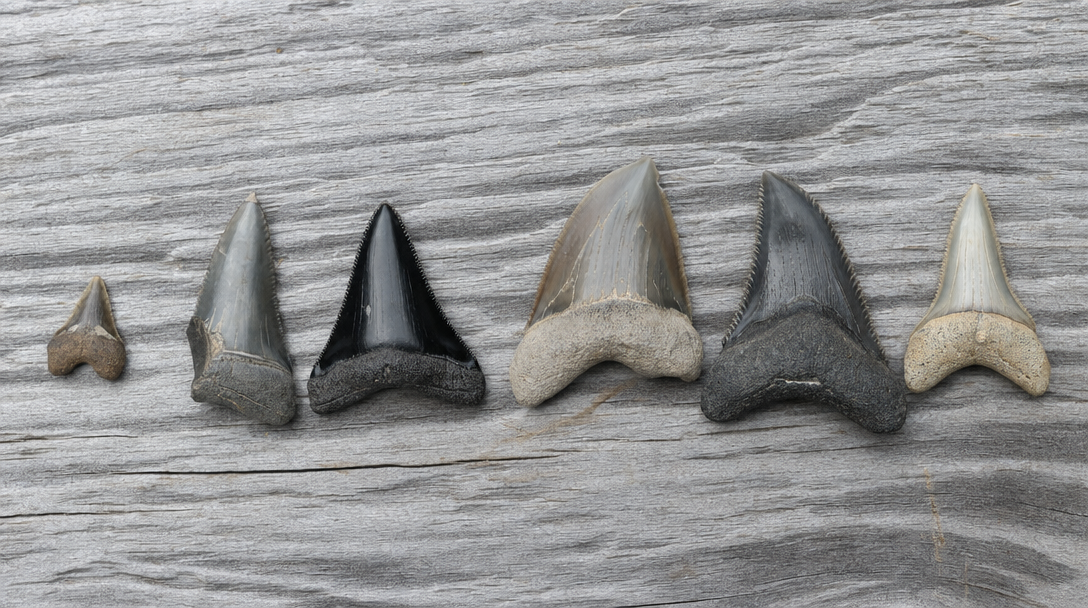
The most expensive mistake in this whole subject is made before anyone talks about money. Charleston sits over beds that produce Otodus angustidens, the megatoothed shark that came before megalodon, and at a glance it reads as a smallish meg. Look at the shoulders of the crown. Angustidens carries a distinct pointed cusplet on each side of the main blade, and its serrations are noticeably coarser. Megalodon has lost those cusplets entirely. A broad triangular tooth with side cusplets is not a juvenile anything — it is the older relative, and it is a different find with a different market.
The geology is why both turn up in the same handful of gravel. The two fossil-bearing units that matter under this part of the coast are Oligocene: the Ashley Formation at roughly 28 to 29 million years, and the Chandler Bridge Formation above it at about 24 to 23 million years. Megalodon itself is far younger — a 2019 review that threw out every reworked and poorly provenanced record put the extinction at about 3.6 million years ago. So a Lowcountry megalodon tooth has been shuffled down out of younger material lying on top of those Oligocene beds, and nothing on the beach sorts the two species for you.
What actually sets the value
Everything below is a condition variable, and they are read in combination rather than scored one by one. The reason a price list is impossible is that the same eight factors can multiply or cancel each other on any given tooth.
The tip is the most fragile part and the first thing lost. Surf rounds it; a hard landing snaps it. Serrations are the second casualty, and they carry the clearest record of how the tooth was treated after it eroded out — crisp and continuous down both edges is a very different object from softened and patchy, even where the outline looks identical. The root is where damage is most common and most visible, because it is porous and it flakes. A complete root with both lobes present, and an unbroken bourlette band between root and crown, is genuinely less common than beginners assume.
Colour is the one people over-read. The dark tone is not the original tooth; minerals from the surrounding sediment replace the original material over a long burial, so the tooth ends up the colour of the mud it sat in. That makes colour a record of the deposit rather than a quality grade or an age. It still moves what people pay, because an even tone with contrast between a dark blade and a paler root photographs well — but a blotchy or bleached tooth is not a worse fossil, only a worse photograph.
| Factor | What lifts the value | What sinks it | Why it matters |
|---|---|---|---|
| Species | Correctly identified megalodon: fine even serrations, no cusplets | Sold as a small meg when the cusplets say angustidens | It is the first thing a serious buyer checks and the most common misdescription |
| Crown | Full outline, unbroken profile, no split blade | Missing corner, cracked face, a section glued back | The crown is most of what you see and most of what cannot be hidden |
| Tip | Sharp and original | Rounded by surf, snapped off, or rebuilt | The most fragile point on the tooth; the first thing a beach find loses |
| Serrations | Crisp and continuous down both cutting edges | Worn smooth, etched, or chipped away in runs | The clearest surviving record of what happened to the tooth after burial |
| Root | Both lobes present, bourlette band unbroken | One lobe gone, root face flaked, heavy fill | Root damage is common, obvious, and expensive to disguise convincingly |
| Colour | Even tone with contrast between blade and root | Blotchy, bleached, or artificially darkened | A record of the burial sediment, not of quality — but it drives what people pay |
| Size | Genuinely large and still complete | Large but rolled, etched, or restored | Size raises the ceiling; condition sets the floor, and the floor decides most sales |
| Provenance | Named locality, lawful collection, restoration disclosed | River unknown, no locality, undisclosed repair | Documentation is the line between a specimen and a souvenir |
Size is the weakest evidence, and the one people trust most
Sales copy loves to convert a tooth into an animal — a five-inch tooth from a sixty-foot shark. The published work does not support that move from an isolated tooth. When Perez, Leder and Badaut applied the standard crown-height method to a single associated megalodon dentition, the estimates for that one individual ranged from 11.4 to 41.1 metres depending on which tooth in the jaw was measured. One animal. The same set of teeth. Their own method, based on summed crown width across an associated dentition, gives a maximum of about 20 metres when extrapolated to the largest known isolated upper tooth.
Take the practical lesson rather than the number. A loose tooth of unknown jaw position cannot tell you how large the shark was, so any listing that quotes a body length as though it were measured is quoting an inference dressed up as a fact. Size still matters to price. It just does not mean what the copy says it means.
"The largest misconception held by many private fossil collectors and potential investors is that the supply of fossils is severely constrained."— Scott Hippensteel and Simon Condliffe, GSA Today (2013)
What the published market data actually found
There is very little real research on fossil prices, and what exists points the opposite way to the usual pitch. Hippensteel and Condliffe gathered more than 1,000 selling prices from 1991, 2001 and 2011 across four fossil types, two of which were Neogene shark teeth. They found the supply of Carcharocles megalodon teeth had increased substantially over those twenty years, as river sites in Georgia and Virginia joined the North Carolina and Florida phosphate mines and the South Carolina rivers that had supplied most of the commercial material in 1991.
Their hypothetical basket — one fossil bought from each of the four groups at the 1991 mean — went from $996 in 1991 to $737 in 2001 to $930 in 2011. That is a fall of 6.7 percent over twenty years, and the authors state plainly that the figures are not adjusted for inflation, which would make the real return worse.
Read that carefully before you repeat it. It is a four-fossil basket, not a megalodon index; the series ends in 2011; and none of it tells you what any particular tooth is worth today. What it does establish is that the scarcity story sold alongside these fossils was not true over the period anyone bothered to measure. Buy a tooth because you want the tooth.
Restoration is normal. Undisclosed restoration is not.
Repair is routine in the trade and not in itself dishonest. Tips get rebuilt, root lobes get cast, fragments get joined, and a good preparator can make the work very hard to see. The standard that matters is disclosure — museums state what has been restored, and a seller should be held to the same line.
- Ask in writing what has been repaired, filled, joined or recoloured, and keep the answer.
- Ask for photographs taken before preparation. A seller who has them will send them.
- Look for a change in surface texture or gloss across a boundary, and for a tip or root lobe whose wear does not match the rest of the tooth.
- If nobody will answer the question, price the tooth as restored. That is the safe assumption, not a rude one.
Provenance, and the line that decides it
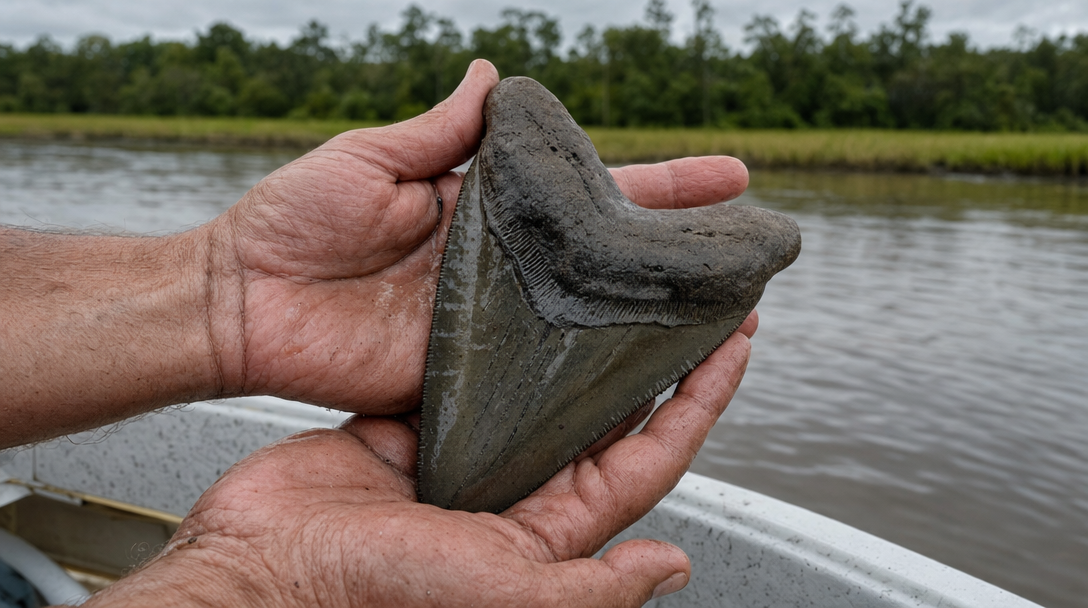
Where a tooth came from is part of what it is worth, and in South Carolina the rule is physical rather than a question of intent. State jurisdiction starts at the mean low water mark. Above that line, picking a tooth off the dry beach is ordinary beachcombing and needs no paperwork. Below it — a creek, a river, any bottom the state holds title to — you need a Hobby License from the South Carolina Institute of Archaeology and Anthropology at the University of South Carolina.
- It is cheap: five dollars for six months in-state and ten out-of-state, or eighteen and thirty-six dollars for two years.
- It covers recreational, non-commercial search and recovery only.
- Hand collection only. No shovels, rakes, scoops or screens, and licensees are never permitted to dig or move sediment to expose material. Magnet fishing is prohibited outright.
- Fossil finds are reported quarterly to the South Carolina State Museum, and the Institute releases title to the licensee within 60 days of receiving each report.
The reason this belongs in a piece about value: a tooth with a named locality and a lawful collection history is documented, and a tooth described as coming from a river somewhere is not. That gap is a discount wherever anyone notices it, and it is the difference between a specimen a museum would accept and one nobody can place.
What a Charleston beach find is realistically worth
Here is the part that gets left out of the excited version. The surf that delivers a tooth onto Morris Island is the same surf that rounded its tip and softened its serrations on the way. Beach finds around here run small, worn, or partial, and the great majority of what a good day produces is sand tiger, with meg fragments and the occasional complete small one. The heavy museum-shaped teeth mostly come out of the rivers, recovered by divers who needed the licence above and who found them lying in sediment rather than rolling in a wash zone.
So the truthful expectation for a day out with us is a pocketful of teeth you will keep for years and, some days, one that stops the boat. What we can tell you on the water is what each of them is, what the tip and the root are telling you, and whether the thing in your palm is a meg or an angustidens. What we will not do is put a number on it from a phone screen, and neither should anyone else. The subject is ours; the trip itself runs out of Shem Creek on the Roamer IV, which carries up to 23.
How to get a real answer on a tooth
- Photograph both faces and the edge-on profile on a plain background, with an object of known size beside it.
- Write down where and how it was collected, and above or below the water line. That note is the provenance.
- Take it to a museum or a university paleontology department for identification before you take it anywhere for valuation.
- Identify before you price. Our field guide to reading size, serrations, root and colour will settle most teeth in a few seconds.
Bring it out on the boat if you are coming anyway. There is no substitute for putting a tooth into the hand of someone who has seen a few thousand of them, and it costs nothing extra to ask.
Pricing, BYOB rules, weather policy, and departure details are all on our FAQ page — or call (843) 874-8555.
Frequently Asked
How much is a megalodon tooth worth?
There is no single figure, and any number quoted from a photograph is a guess. Condition does most of the work: whether it is really megalodon, whether the tip is original, whether the serrations are crisp down both edges, whether the root is complete, how even the colour is, and whether the origin is documented. A small flawless tooth regularly outranks a larger damaged one. A real answer needs the tooth in hand.
Does a bigger megalodon tooth always mean more money?
No. Size raises the ceiling, not the floor. A large tooth with a rolled tip, worn serrations or a missing root lobe competes badly against a smaller complete one, and heavily restored large teeth are common. Size is also poor evidence of the animal: applying the standard crown-height method to a single associated megalodon dentition produced body-length estimates from 11.4 to 41.1 metres for that one shark, depending on which tooth was measured.
Are black megalodon teeth worth more than brown ones?
Colour comes from the minerals in the sediment the tooth was buried in, not from the animal, the species or the age, so it is not a quality grade. It does affect what people pay, because an even tone with contrast between a dark blade and a paler root photographs well. Evenness matters more than which colour you have.
How can I tell if a megalodon tooth has been restored?
Look for a change in surface texture or gloss across a boundary, seams, and a tip or root lobe whose wear does not match the rest of the tooth. The practical test is to ask the seller in writing what has been repaired, filled, joined or recoloured, and to ask for photographs taken before preparation. Museums disclose restoration as a matter of course; hold a seller to the same standard, and if the question goes unanswered, assume the tooth is restored.
Is my Charleston tooth a megalodon or Otodus angustidens?
Check the shoulders of the crown. Angustidens carries a pointed cusplet on each side of the main blade and has noticeably coarser serrations; megalodon has no cusplets at all. Charleston sits over Oligocene beds that produce angustidens routinely, so a small broad triangle with side cusplets is the older relative rather than a juvenile meg.
Do you need a license to collect fossil teeth in South Carolina?
It depends where you are standing. Above the mean low water mark, surface collecting from the dry beach needs no license. Below that line, including creeks and rivers, you need a Hobby License from the South Carolina Institute of Archaeology and Anthropology — five dollars for six months for residents and ten for non-residents. It permits hand collection only, with no digging, tools or screens anywhere in state waters, and finds are reported quarterly to the South Carolina State Museum.
Can I sell a fossil tooth I found in South Carolina?
Title to material recovered under a Hobby License passes to the licensee after the quarterly report is reviewed, and the Institute releases title within 60 days of receiving it. The license itself covers recreational, non-commercial search and recovery, so anything beyond that is a separate question — ask the Institute directly before selling material recovered under it. A tooth picked up off the dry beach above the low water mark is ordinary beachcombing.
What is the bourlette on a megalodon tooth?
The darker chevron-shaped band sitting between the root and the enamelled blade. It is a normal feature of megalodon and its relatives, it flakes easily, and an unbroken bourlette is one of the things collectors look for when judging how well a tooth has survived.
Local captain with LowCountry Coastal Excursions, running tours out of Shem Creek since 2017.